
Foods That Cause Man Breasts (and What to Eat Instead)
Most foods don't directly cause man breasts, but heavy drinking, ultra-processed food and extra body fat can add to chest fat. Here's what diet can and can't change.
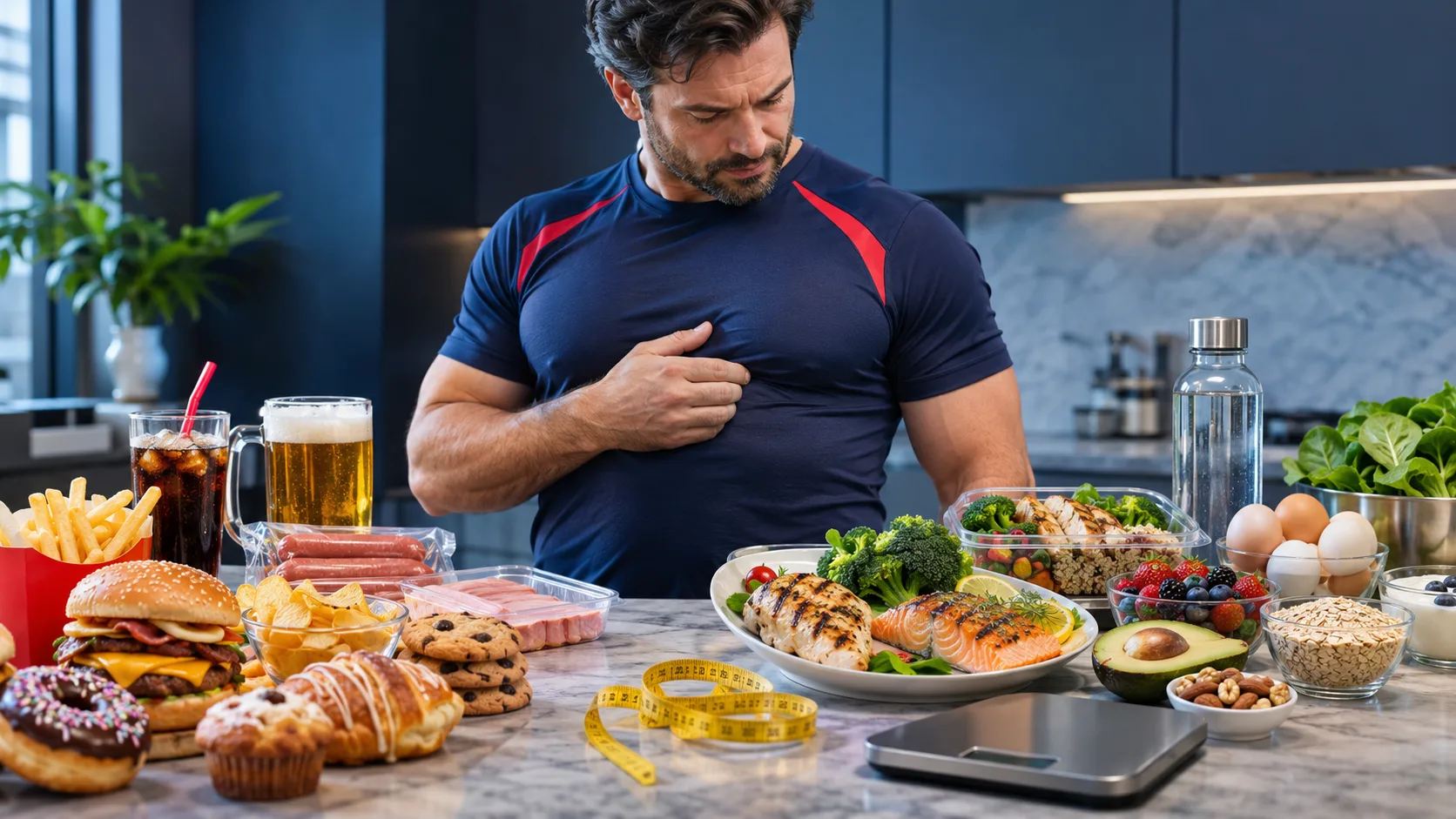
Searches for foods that cause man breasts are common, and the question usually comes from the same worry: your chest looks fuller than it used to. The short answer is that no single food has been shown to grow male breast tissue on its own. Many men, though, carry extra chest fat, and certain eating patterns, especially heavy drinking and diets built on ultra-processed food, can add to it. This guide explains which foods and drinks may matter, what a diet for man breasts can and cannot change, and what to eat instead. If you want the full picture first, read our guide on how to get rid of man breasts, which compares diet, exercise, medication and surgery side by side.
Key takeaways
- No single food has been shown to cause gynecomastia (enlarged glandular breast tissue) on its own.
- Diet can reduce chest fat, which is what many men with a fuller chest are noticing, but it cannot dissolve firm glandular tissue.
- Heavy, regular alcohol use is one of the better-established dietary links to gynecomastia.
- Ultra-processed food, sugary drinks and excess calories may add body fat, including on the chest.
- A diet for man breasts works through steady fat loss, built on protein, vegetables, whole grains and healthy fats.
- A firm lump, a one-sided growth, nipple discharge or skin dimpling needs a doctor, not a meal plan.
Foods that cause man breasts: what the evidence shows
Not directly, in most cases. Gynecomastia reflects a change in the balance between estrogen and androgen activity in breast tissue, and it has several recognized triggers. A widely cited review in the New England Journal of Medicine describes these causes, which include normal hormonal shifts during puberty and in older age, certain medications and drugs, liver disease, low testosterone, some hormone-producing tumors, and obesity. In many men, no clear cause is found.
Food, then, is rarely the root cause. It can, however, influence the two factors that matter most here: how much fat you carry on your chest, and how much alcohol your liver has to process. That is why diet keeps coming up, and why it is worth separating what food can do from what it cannot.
Fat or gland: why the difference matters
Men who notice a fuller chest are usually dealing with one of two things. Pseudogynecomastia is an increase in chest fat with little or no increase in gland. Gynecomastia is an increase in glandular tissue directly behind and around the nipple, and it can occur with or without extra fat.
The distinction matters because diet acts on fat, not on gland. Weight loss can make a fatty chest look flatter, but it does not reduce the gland itself. A firm, disc-like area behind the nipple will usually remain.
Surgeons often describe gynecomastia using the Simon classification, which grades it from I to IV according to how much gland and excess skin are involved. You do not need to know your grade to make dietary changes. It does help to understand that the gland is a separate issue from fat.
What the research does and does not show
Much of the advice online about so-called man boob foods rests on lab work, animal studies or anecdote. Human research is more limited and more cautious. It supports a few clear points: heavy alcohol use, certain medications and anabolic steroids are linked to gynecomastia, and excess body weight is linked to more chest fat.
What the evidence does not show is that ordinary, balanced eating causes breast enlargement in men. Most of the foods you may have read about are better understood as contributors to body fat or as small, uncertain factors, rather than proven causes.
Pseudogynecomastia vs gynecomastia: what diet can and cannot change
Diet can help with fat-based chest enlargement, but it cannot change glandular tissue. The table below sets out the difference so you can judge what a food plan might realistically do.
| Feature | Pseudogynecomastia (mainly fat) | Gynecomastia (glandular tissue) |
|---|---|---|
| What is enlarged | Fatty tissue across the chest | Glandular tissue directly behind and around the nipple |
| What it may feel like | Soft, spread out, moves with the rest of the chest | Firmer, more defined, sometimes like a flat disc or rubbery ridge; may be tender |
| Can diet change it? | May reduce it, with sustained weight loss | Usually not; diet cannot dissolve gland |
| Typical effect of weight loss | Chest may look flatter and more defined | Chest may look slightly flatter, but the gland usually persists |
| Usual next step | Lifestyle changes; sometimes liposuction | A doctor's assessment to confirm the cause and options |
A simple way to think about your own chest is to compare it with the rest of your body. If your chest looks similar to your stomach and arms and feels soft, fat is likely the main factor. If a firm area sits directly behind the nipple, it may be glandular. Only a doctor or surgeon can confirm which it is.
Foods and drinks that may add chest fat or affect hormones
Alcohol, ultra-processed food and sugary drinks are the foods most likely to matter. They either push up body fat or affect how the liver handles hormones. Other foods are often blamed, but the evidence for them is weaker.
Alcohol: the most established dietary link
Heavy and regular drinking is one of the better-established dietary links to gynecomastia. Alcohol can damage the liver, and the liver plays a central role in clearing estrogen from the body. Alcohol also adds calories that are easy to overlook, and over time these can translate into more body fat, including on the chest.
Occasional drinking is less clearly linked. A practical first step is to track what you drink for one week, noting how many drinks you have, how often, and how large the measures are. Then compare that with what your doctor recommends for you.
If you drink heavily every day, do not stop suddenly on your own. Withdrawal can be dangerous, and a doctor can help you reduce safely.
Ultra-processed food and sugary drinks
Diets built on ultra-processed food, sugary drinks and refined carbohydrates tend to be high in calories and low in fiber and protein. That combination makes it easy to gain weight without feeling full. The main way these foods link to a fuller chest is through body fat.
Fat tissue contains an enzyme called aromatase, which converts some androgens into estrogen. This is one reason heavier men may carry more chest fat, although the size of the effect varies widely between people. Reducing body fat may reduce this activity, which is one more reason weight loss is worth pursuing even when it does not change the gland.
Soy and phytoestrogen foods
Soy is often named as a cause, largely because it contains isoflavones, plant compounds with weak estrogen-like activity. The concern sounds reasonable, but the evidence for normal eating is reassuring. Studies of usual soy food intake, such as tofu, edamame and soy milk, have not shown a consistent link to gynecomastia in men.
Concentrated soy supplements and isolated soy extracts are less well studied, so it makes sense not to rely on them as a high-dose daily supplement. If you are concerned about soy, bring it up with your doctor, who can consider your overall diet and any medicines you take.
Licorice and herbal hormone products
Black licorice and licorice root contain glycyrrhizin, a compound that can raise blood pressure and lower potassium when eaten in large amounts. Heavy use has also been linked to lower testosterone. Licorice-flavored sweets are usually fine in moderation, but large amounts of concentrated licorice root are not a sensible daily habit.
Herbal hormone balance teas, capsules and estrogen blocker products are often marketed with broad claims. The evidence for most of them is weak, doses vary, and some are not regulated the way medicines are. Avoid any product that promises to shrink breast tissue, and speak to a doctor before taking herbal products, especially if you take other medicines.
Bodybuilding products, prohormones and anabolic steroids
This is the category with the clearest link to gynecomastia. Anabolic steroids and prohormones can increase estrogen levels or suppress natural testosterone, and either effect can enlarge breast tissue. Some supplements sold for muscle gain have been found to contain undeclared ingredients, which makes it hard to know exactly what you are taking.
If you use these products, speak with a doctor who can review what you are using in confidence. Do not stop any prescribed medicine on your own, and do not start or change any hormone treatment without medical supervision.
Prescribed medicines
Some heart, stomach, psychiatric and hormone-related medicines are known to be linked to gynecomastia. This is a reason to tell your doctor about any breast change, rather than adjusting your medicines yourself. Never stop or change a prescribed medicine without speaking to the prescriber. Ask whether a medicine could be contributing and whether an alternative exists.
A diet for man breasts: what to eat instead
A diet for man breasts works like any sensible fat-loss plan: a steady calorie deficit built on protein, vegetables, fiber and healthy fats. No food melts chest fat, and you cannot spot-reduce fat from one area by training or eating differently. The aim is an eating pattern you can keep for months, not a short-term fix.
Build meals around protein and vegetables
Protein keeps you full and helps you hold on to muscle while you lose fat. Good options include eggs, fish, skinless chicken or turkey, lean beef, Greek yogurt, lentils, beans and tofu. Fill half your plate with vegetables, which add volume and fiber for relatively few calories.
Choose whole grains, fruit and beans
Swap refined white bread, white pasta and sugary breakfast cereals for oats, brown rice, quinoa, whole-grain bread and higher-fiber cereals. Whole fruit is a better snack than juice, which concentrates sugar without the fiber. Beans and lentils combine protein and fiber, which makes them among the most useful staples for a diet for man breasts.
Use healthy fats in measured amounts
Olive oil, nuts, seeds, avocado and oily fish such as salmon or sardines provide healthy fats. They are also calorie-dense, so measure them rather than pouring freely. One small handful of nuts and a tablespoon of oil go a long way.
Keep drinks simple
Water, sparkling water, unsweetened tea and black coffee cover most needs. Fruit juice, soft drinks, energy drinks and sweetened coffees add calories with little fullness. If you drink alcohol, keep it occasional and track it.
Sleep and stress also matter
Short sleep is linked to higher appetite and stronger cravings, and chronic stress can push eating toward high-sugar, high-fat food. Going to bed at a consistent time and building short walks into your day can make the rest of your plan easier to follow.
Swap guide
| Instead of | Try | Why it helps |
|---|---|---|
| Sugary soft drinks or energy drinks | Sparkling water, unsweetened tea or black coffee | Removes liquid calories that do little for fullness |
| White bread or sugary cereal | Oats, whole-grain bread or higher-fiber cereal | More fiber keeps you fuller for longer |
| Fried takeaway | Grilled or baked protein with vegetables | Lowers fat and calorie load per meal |
| Crisps or biscuits most evenings | Fruit, a small portion of nuts, or Greek yogurt | Adds protein and fiber to snacks |
| Beer or spirits most nights | Alcohol-free days and smaller measures | Reduces calories and strain on the liver |
| Unlabeled protein bars or shakes | Whole-food protein such as eggs, fish or yogurt | Avoids products with unclear ingredients |
| Cream-heavy sauces | Tomato-based or yogurt-based sauces | Less saturated fat and fewer calories |
A sample day
This is an illustration, not a prescription. Portions should suit your size, activity level and any medical conditions. A registered dietitian or your doctor can set appropriate targets.
- Breakfast: oats cooked with milk or water, topped with berries and a spoonful of Greek yogurt.
- Lunch: grilled chicken or chickpeas over mixed leaves, with cucumber, tomato and an olive-oil dressing.
- Snack: an apple with a small handful of almonds.
- Dinner: baked salmon, roasted vegetables and a portion of quinoa or brown rice.
- Drinks: water through the day, with unsweetened tea or black coffee.
Pseudogynecomastia diet: what to expect and how long it takes
A pseudogynecomastia diet can reduce chest fat, but the changes usually take months rather than weeks. Results depend on starting weight, age, genetics and how much of the enlargement is fat rather than gland. Many men notice a flatter chest first, then a sharper outline as their overall body fat drops.
What a pseudogynecomastia diet can realistically achieve
If your chest enlargement is mainly fat, a sustained eating plan may make a visible difference. Weight loss reduces fat across the whole body, including the chest, but you cannot choose where that fat comes from. For some men the chest is one of the last areas to change.
If the enlargement is mostly gland, the chest may look slightly flatter after weight loss, but the firm tissue behind the nipple will usually remain. That is the point where a doctor's assessment becomes the right next step.
Pace matters more than speed
Crash diets often cost muscle and water weight, and the weight tends to return. Gradual weight loss is generally easier to keep off and easier on your body. Track your waist measurement and take photos in the same lighting every few weeks, because the scale alone can be misleading.
How the options compare
| Option | What it targets | What it cannot do | Typical timeline |
|---|---|---|---|
| Diet and weight loss | Body fat, including the chest | Shrink firm gland or reduce fat from one spot only | Months, with steady effort |
| Chest exercise | Muscle beneath the tissue; posture | Remove fat or gland; the muscle sits under the tissue | Weeks to months, alongside diet |
| Medical review | Possible causes such as medicines, hormones, liver health | Work as a cosmetic fix on its own | Depends on tests and findings |
| Surgery (VASER liposuction and/or gland excision) | Fat and gland, depending on the package | Address lifestyle causes; scars are part of the procedure | Surgery 1–2 hours; final result 3–6 months |
Diet mistakes that waste time and money
The most common mistakes are predictable, and most of them slow progress rather than speed it up.
- Crash dieting that is impossible to sustain, leading to rebound weight gain.
- Chest-only exercises. Chest training builds the muscle beneath the tissue, but it does not reduce the fat on top.
- Detox teas and fat-burning supplements with unclear ingredients and no good evidence behind them.
- Estrogen blocker products that promise results they cannot prove.
- Ignoring alcohol, which is one of the few dietary factors with a reasonably well-established link.
When a diet is not enough: signs you need a doctor
See a doctor promptly if you notice any of the following. These signs do not mean something serious is happening, but they should be checked rather than managed with diet alone.
See a doctor promptly if…
- you can feel a hard or fixed lump in your breast or chest
- a one-sided lump is growing or changing
- you have nipple discharge, especially if it is bloody or happens without squeezing
- the skin over your chest is dimpling, puckering or pulling in
- you have chest pain with breathlessness, which needs emergency services right away
A doctor can examine your chest, ask about your medicines, supplements, alcohol use and any recent changes, and may order blood tests for hormones and liver function. Your GP is the usual first point of contact if you are unsure what you are seeing. The NHS guidance on male breast reduction explains the condition and the options, and it is a useful place to start reading before that appointment.
How to tell whether your chest is fat or gland
You can get a rough idea at home, but only a clinician can confirm which type of tissue you have. Gently feel the area behind and around your nipple, comparing it with the rest of your chest. Fat tends to feel soft and spread out, and it moves with the rest of your body. Glandular tissue often feels firmer and more defined, sometimes like a flat disc or rubbery ridge directly behind the nipple, and it may be slightly tender.
If you are unsure, or the feeling does not match what you see in the mirror, a free photo assessment can help you take the next step. Send two photos, one from the front and one from the side, to our team by WhatsApp on +90 505 026 5581 or by email at info@gynecomastiasurgeryturkey.com. A surgeon reviews your photos and returns a fixed quote within 24 hours. The service is free and carries no obligation.
Gynecomastia surgery in Turkey: when a diet is not enough
If diet and lifestyle changes have not made a difference, or if your assessment shows that glandular tissue is involved, surgery may be worth considering. Many men look into gynecomastia surgery in Turkey because it combines hospital-based care in Istanbul with an all-inclusive package. Our clinic is based in Etiler, Istanbul, and performs surgery in JCI-accredited private hospitals in Istanbul and Ankara.
2026 packages at a glance
All packages are all-inclusive. Flights are not included.
| Package | Best suited to | 2026 price |
|---|---|---|
| VASER liposuction only | Grade I, pseudogynecomastia (fat only) | $2,500 |
| VASER + gland excision | Grade I–II (our most popular package) | $3,000 |
| Hi-Def VASER + excision | Gland removal with more detailed contouring | $3,500 |
| Grade III–IV with skin tightening and nipple repositioning | Grade III–IV, including excess skin | $4,200 (includes 1 hospital night) |
| Gynecomastia + full-torso VASER | Gland removal with wider body contouring | $5,500 |
For comparison, the typical home price quoted on this site is about $8,000 in the USA and £5,500–6,500 in the UK.
What is included and how the trip works
Each package includes the surgery itself, the anesthesiologist, hospital care, 3–5 nights in a 5-star hotel, VIP transfers, a translator, a compression vest, medications, pre-operative tests, histology, nurse visits on days 2 and 3, video follow-ups at weeks 1, 2, 4 and 8, and lifetime WhatsApp aftercare.
The trip usually lasts 4–6 days. Surgery takes 1–2 hours under general anesthesia. Most patients fly home on day 3 or 4, while grade III–IV procedures usually mean flying home on day 5 or 6.
Recovery timeline
| Activity | Typical timeline |
|---|---|
| Desk work | 5–7 days |
| Lower-body gym training | About 2 weeks |
| Chest training | 4–6 weeks |
| Compression vest | 4–6 weeks |
| Final result | 3–6 months |
Who is a candidate?
Candidates are generally required to meet the following criteria:
- Aged 18 or over. Patients aged 16–17 are considered only with parental consent and a stable gland for at least 2 years.
- A stable weight for 6 months. If your diet is still in progress, you may be asked to wait until your weight has settled.
- No anabolic steroids or prohormones for at least 3 months before surgery. Do not stop any prescribed medicine without medical advice.
- Non-smoker for 4 weeks before and after surgery.
Clinic figures
The clinic reports these figures from its own internal audit, which has not been peer-reviewed: more than 5,000 procedures, a revision rate under 1%, 98% patient satisfaction, a 4.9/5 rating, and patients from more than 50 countries. Treat these as the clinic's own internal figures rather than independent evidence, and as context rather than guarantees.
Diet is a sensible first step for many men with fat-only enlargement. For glandular tissue it is a starting point, not a solution, and a clear assessment will show you what is realistic for your own chest.
Frequently asked questions
Straight answers from our surgical team.
Can foods cause man breasts?
Does soy cause man breasts?
Can alcohol cause man breasts?
What is a diet for man breasts?
Can a pseudogynecomastia diet get rid of chest fat?
How long does a diet take to change the chest?
Do I need a doctor before starting a diet for man breasts?
Get your free surgical assessment
Send two chest photos (front and side). A board-certified surgeon reviews them and you receive a personal plan and an exact all-inclusive price within 24 hours.
No obligation. Your photos are deleted on request. or call +90 505 026 5581
- 1.Send photos
- 2.Surgeon review
- 3.Fixed quote in 24h
This guide is for educational purposes and does not replace a consultation with a qualified surgeon.
Related guides
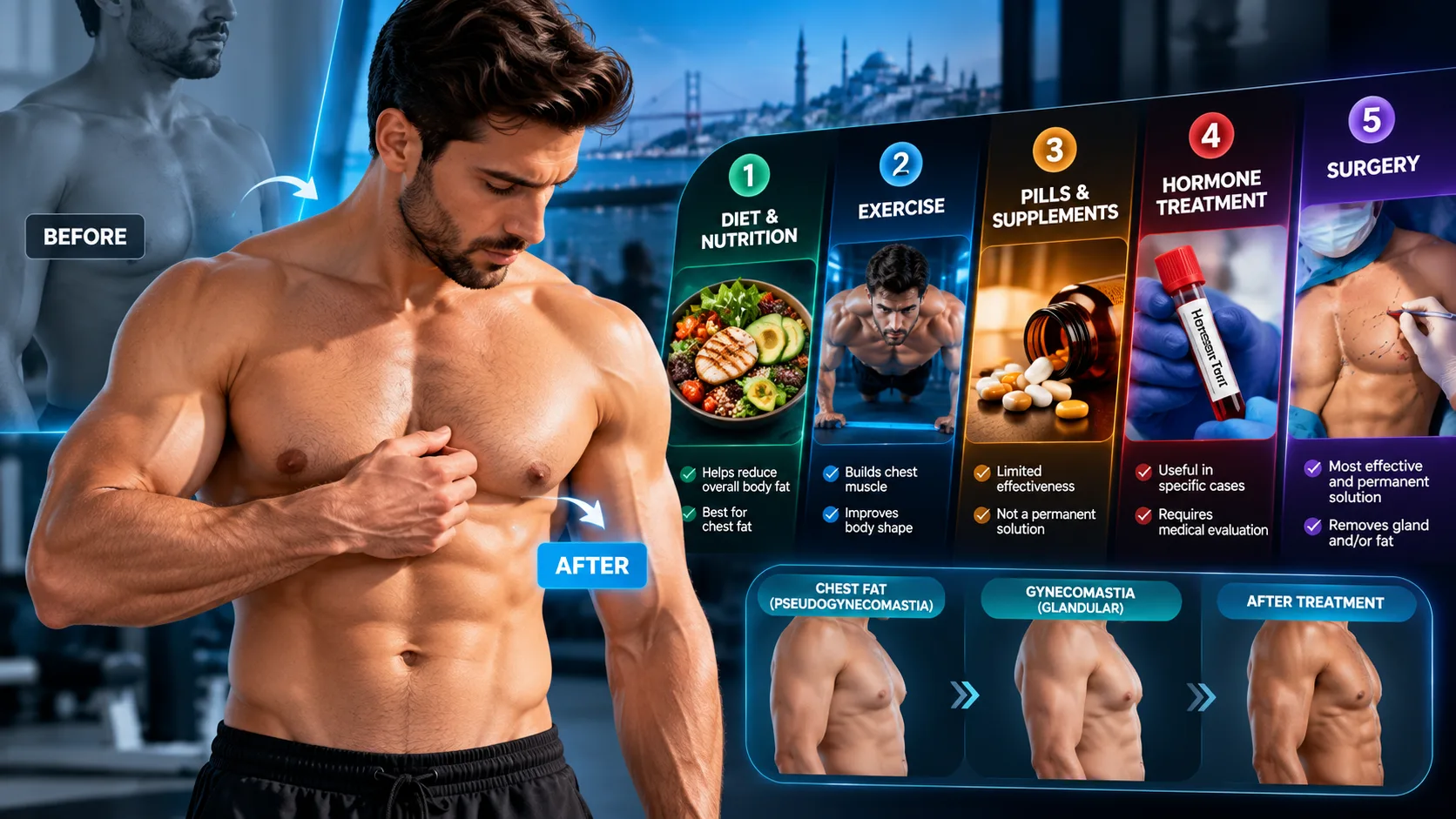
How to Get Rid of Man Breasts: Every Option Ranked (Diet, Exercise, Pills, Surgery)
Diet and exercise can shrink chest fat, but only surgery removes gland. This guide ranks every option for man breasts, with honest notes on costs, timelines and risks.