Skip to content

Etiler, B16. n23, Istanbul, Turkey

Gynecomastia surgery in Turkey from $2,500, all-inclusive

VASER liposuction and complete gland excision by board-certified male-chest specialists in JCI-accredited Istanbul hospitals. Send 2 photos and get a fixed quote within 24 hours.

  • All-inclusive from $2,500
  • 5,000+ gynecomastia procedures
  • Revision rate under 1%
  • Reply within 24 hours

Send 2 chest photos on WhatsApp. A surgeon replies within 24 hours.

Gynecomastia surgery in Turkey: surgeon marking the chest before VASER liposuction and gland excision
JCI-accredited hospitalsIstanbul, Turkey

All-inclusive

from $2,500

All-inclusive from
$2,500
vs. USA & UK
-65%
Procedure time
1-2 h
Back to work
5-7 d
JCI accredited Ministry of Health ISAPS members EBOPRAS certified

JCI

Surgery at Turkey's leading JCI-accredited hospitals

We operate exclusively in internationally accredited private hospitals in Istanbul and Ankara.

  • Memorial Hospitals Group
  • Medical Park Istanbul
  • Liv Hospital
  • Guven Hospital
  • Biruni University Hospital
  • BHT Clinic Istanbul Tema Hospital
  • Acibadem Healthcare Group
  • Medical Park Hospitals
  • Medicana Health Group

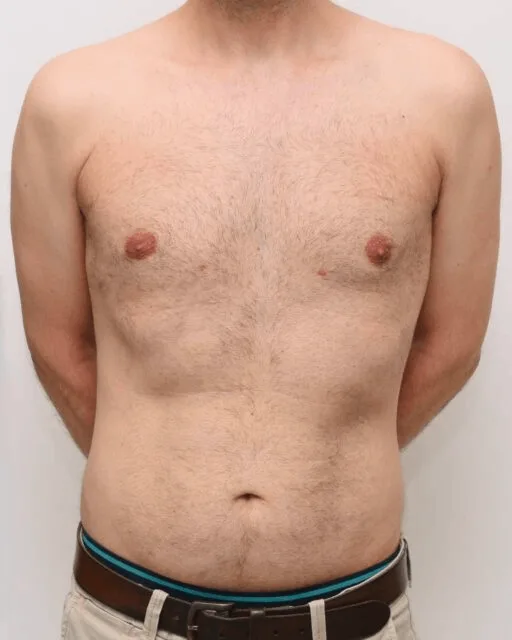
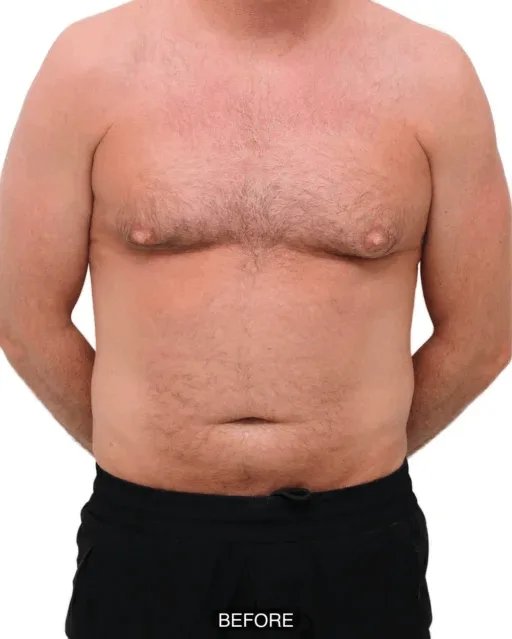
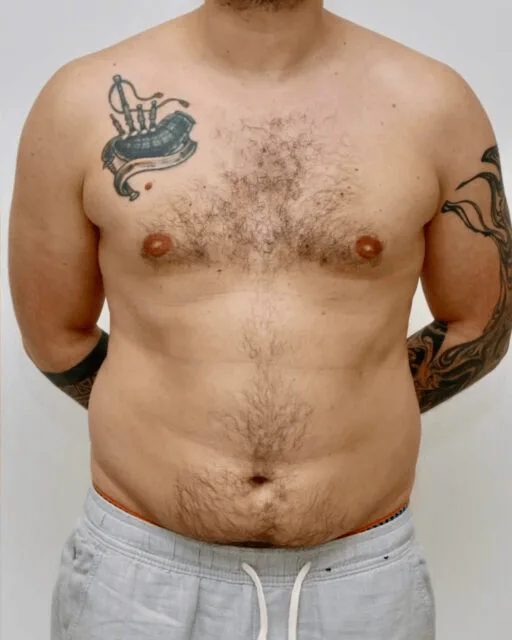
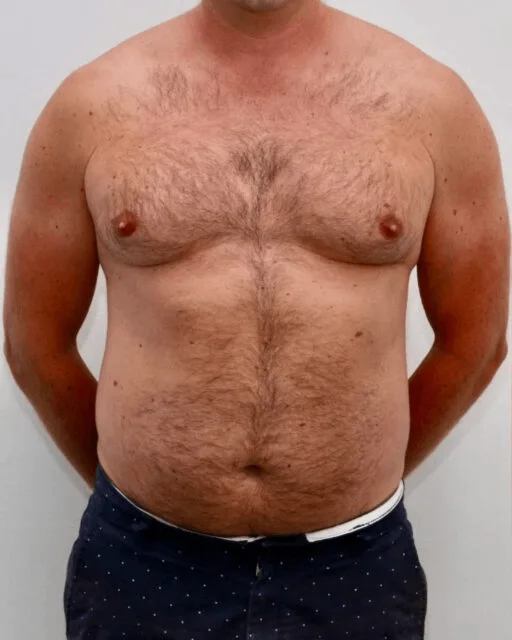
Before / After

Real patients, real results. Photos shared with written consent.

View full gallery
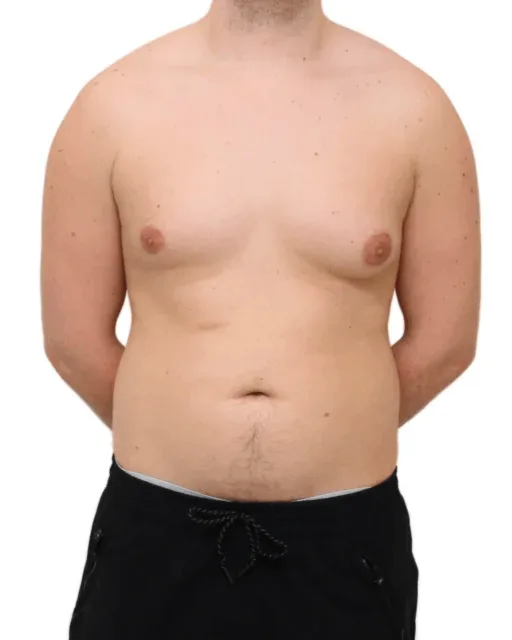
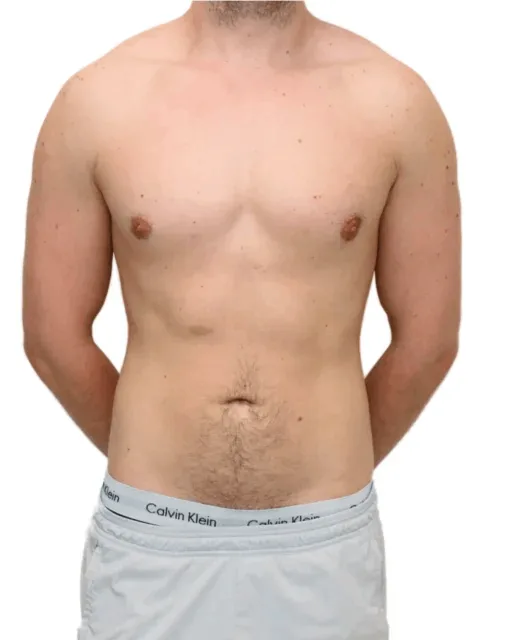
  • Before: This man in his 20s had long-standing gynaecomastia present since his teenage years, more pronounced and occasionally painful on the left side, which had persisted despite medical treatment. Surgery was performed under general anaesthesia using liposuction and direct gland excision through small areolar incisions. The photographs show his result at six months: a flatter, symmetrical chest with minimal scarring.
    Before
    After: This man in his 20s had long-standing gynaecomastia present since his teenage years, more pronounced and occasionally painful on the left side, which had persisted despite medical treatment. Surgery was performed under general anaesthesia using liposuction and direct gland excision through small areolar incisions. The photographs show his result at six months: a flatter, symmetrical chest with minimal scarring.
    After
    Gynaecomastia surgery for long-standing chest asymmetry6 months post-op
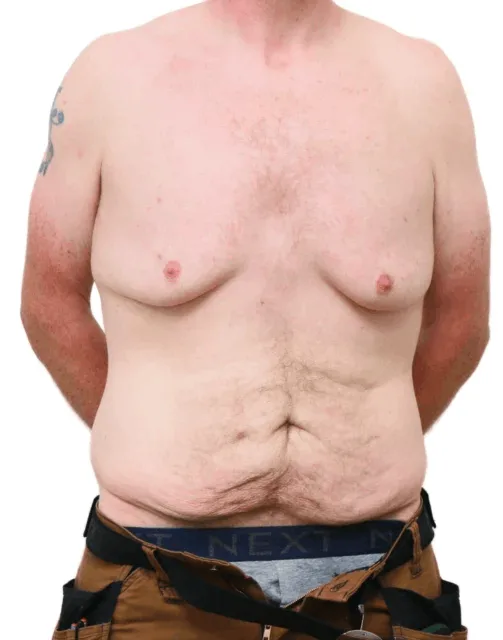
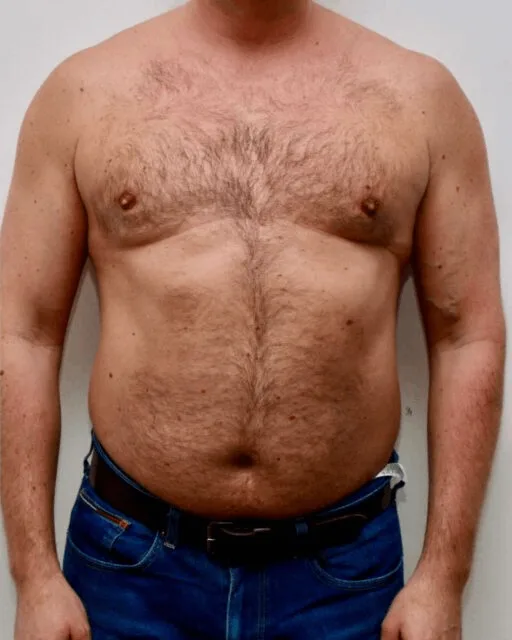
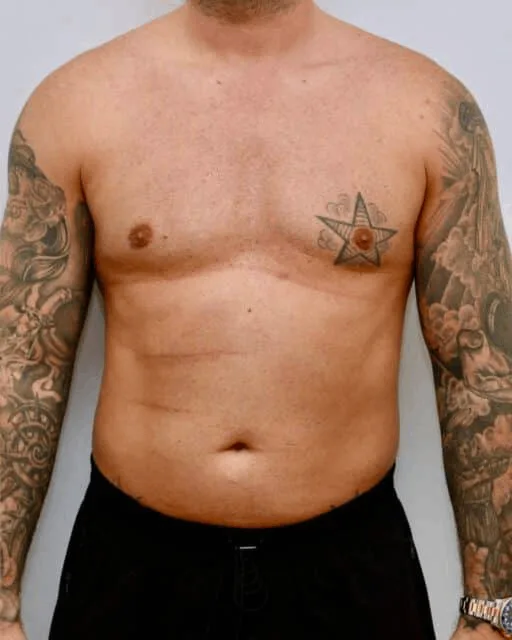
  • Before: This patient, aged 37, lost over 6 stone and had maintained a stable weight for a year, leaving him with significant loose skin on his chest and abdomen. He underwent skin excision to the chest with free nipple grafting alongside a full tummy tuck (abdominoplasty) to remove the overhanging abdominal skin. The photographs show a flatter chest and a smoother abdominal contour.
    Before
    After: This patient, aged 37, lost over 6 stone and had maintained a stable weight for a year, leaving him with significant loose skin on his chest and abdomen. He underwent skin excision to the chest with free nipple grafting alongside a full tummy tuck (abdominoplasty) to remove the overhanging abdominal skin. The photographs show a flatter chest and a smoother abdominal contour.
    After
    Skin removal from chest with free nipple grafting and abdominoplasty6 months post-op
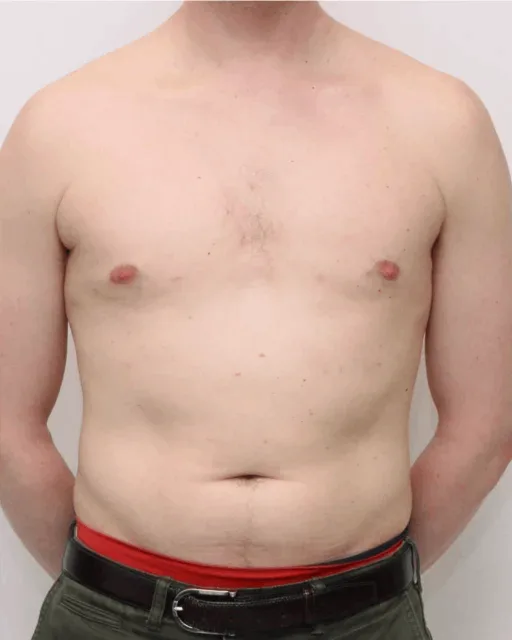
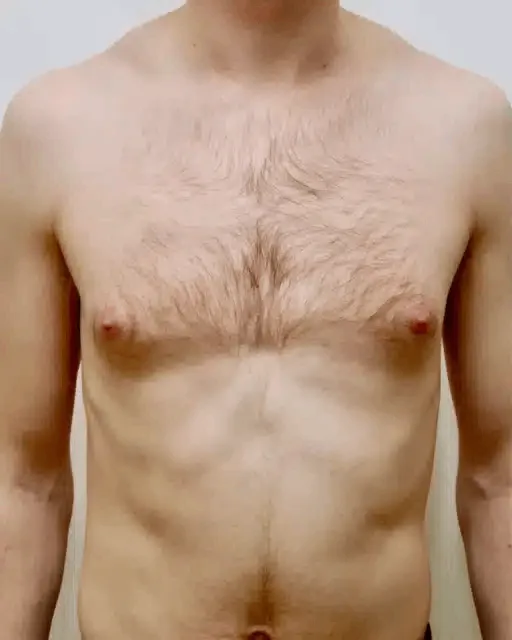
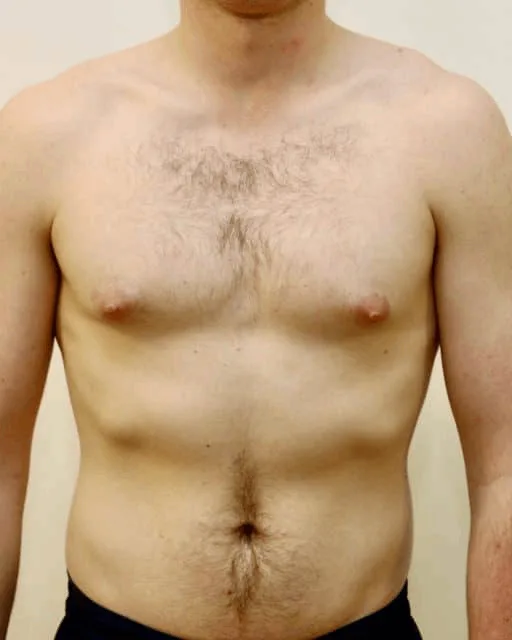
  • Before: He had standard tumescent liposuction with 450cc of fat removed. His result is shown at 6 months.
    Before
    After: He had standard tumescent liposuction with 450cc of fat removed. His result is shown at 6 months.
    After
    Gynecomastia liposuction result6 months post-op
  • Before: This patient underwent male breast reduction surgery at Waterfront Private Hospital in Edinburgh for long-standing excess chest tissue — a mix of fatty and glandular tissue that had persisted despite a healthy weight and active lifestyle.  The procedure involved liposuction only, with 500cc of fat removed under general anaesthesia. The photographs show a flatter chest with an improved contour at his follow-up review.
    Before
    After: This patient underwent male breast reduction surgery at Waterfront Private Hospital in Edinburgh for long-standing excess chest tissue — a mix of fatty and glandular tissue that had persisted despite a healthy weight and active lifestyle.  The procedure involved liposuction only, with 500cc of fat removed under general anaesthesia. The photographs show a flatter chest with an improved contour at his follow-up review.
    After
    Liposuction for male breast reduction6 months post-op
  • Before: Standard liposuction only gynecomastia correction
    Before
    After: Standard liposuction only gynecomastia correction
    After
    Standard liposuction only gynecomastia correction6 months post-op
  • Before: This man in his 20s had long-standing gynaecomastia present since his teenage years, more pronounced and occasionally painful on the left side, which had persisted despite medical treatment. Surgery was performed under general anaesthesia using liposuction and direct gland excision through small areolar incisions. The photographs show his result at six months: a flatter, symmetrical chest with minimal scarring.
    Before
    After: This man in his 20s had long-standing gynaecomastia present since his teenage years, more pronounced and occasionally painful on the left side, which had persisted despite medical treatment. Surgery was performed under general anaesthesia using liposuction and direct gland excision through small areolar incisions. The photographs show his result at six months: a flatter, symmetrical chest with minimal scarring.
    After
    Gynaecomastia surgery for long-standing chest asymmetry6 months post-op
  • Before: This young man had 550cc standard liposuction and a small gland excision (approximately 15g on each side) to treat gynecomastia. The before-and-after images show his result at six months.
    Before
    After: This young man had 550cc standard liposuction and a small gland excision (approximately 15g on each side) to treat gynecomastia. The before-and-after images show his result at six months.
    After
    Liposuction and gland excision
  • Before: gynecomastia
    Before
    After: gynecomastia surgery result
    After
    Excision of localised glandular gynecomastia - no skin excision7 months post-op
  • Before: This man is in his early 40s. He had longstanding gynecomastia since his teenage years and felt increasingly self-conscious when wearing shirts.
    Before
    After: This man is in his early 40s. He had longstanding gynecomastia since his teenage years and felt increasingly self-conscious when wearing shirts.
    After
    High volume liposuction for gynecomastia6 months post-op
  • Before: Excision of localised glandular gynecomastia under local anaesthesia
    Before
    After: Excision of localised glandular gynecomastia under local anaesthesia
    After
    Excision of localised glandular gynecomastia under local anaesthesia
  • Before: This man in his early 30s was self-conscious about the appearance of his chest. He had standard tumescent liposuction (300cc total) and gland excisions through small cuts around the lower half of the nipples (10-15 grams of tissue removed on each side).
    Before
    After: This man in his early 30s was self-conscious about the appearance of his chest. He had standard tumescent liposuction (300cc total) and gland excisions through small cuts around the lower half of the nipples (10-15 grams of tissue removed on each side).
    After
    Male breast reduction using liposuction and gland excision6 months post-op
  • Before: gynecomastia
    Before
    After: gynecomastia surgery result
    After
    Gynecomastia liposuction and gland excision before and after

Results vary from patient to patient. Photos are shown with patient consent.

How your medical trip works

From the first photo to your final follow-up, every step is organised for you.

  1. 01

    Free online assessment

    Send two photos on WhatsApp. A surgeon confirms your grade, technique and a fixed all-inclusive price within 24 hours.

  2. 02

    Fly to Istanbul

    VIP transfer from the airport to your 5-star hotel. Pre-op tests and your surgeon consultation happen the same or next day.

  3. 03

    Surgery day

    1 to 2 hours in a JCI-accredited hospital. VASER liposuction, gland excision or both, under general anaesthesia.

  4. 04

    Recovery and flight home

    Daily nurse check-ups at the hotel, compression vest fitted, and you fly home on day 3 or 4 with lifetime WhatsApp aftercare.

ISAPS · EBOPRAS

Board-certified plastic surgeons who specialise in male chest contouring.

Your surgical team

Gynecomastia surgery is a 1-2 hour procedure that removes the firm breast gland and the excess fat from a man's chest, leaving it flat and masculine. At Gynecomastia Turkey in Istanbul, Turkey, the all-inclusive price in 2026 starts at $2,500 for VASER liposuction alone and $3,000 for VASER plus gland excision. The same operation costs about $8,000 in the USA and GBP 6,500 in the UK. Our package covers the surgeon, a JCI-accredited hospital, a 5-star hotel, transfers, a translator and lifetime aftercare. Flights are the only thing you add.

Our surgical team has completed more than 5,000 gynecomastia procedures for patients from over 50 countries. Each surgeon is board-certified, a member of ISAPS and EBOPRAS, and has more than 15 years of experience in male chest contouring. We reply to every photo assessment within 24 hours with a fixed quote. This page explains what gynecomastia is, which technique fits your grade, what surgery day feels like, what it costs, the honest risks, and how recovery unfolds week by week.

If you have been searching for man boobs surgery, gyno surgery or male breast reduction, you are reading about the same operation under different names. Doctors call it subcutaneous mastectomy or gynecomastia correction. We use the term gynecomastia surgery throughout this page because it is the phrase most men use when they first contact us, and it is the one you will see in medical studies.

01

Key takeaways

  • Gynecomastia (enlarged male breast tissue) affects 30-65% of adult men at some point; surgery is the only reliable fix for a firm gland that has been there for more than 12 months.
  • Gynecomastia surgery in Turkey costs $2,500-5,500 all-inclusive at Gynecomastia Turkey in 2026, compared with $6,500-15,000 in the USA and GBP 5,000-12,000 in the UK.
  • The most popular package, VASER liposuction plus gland excision, costs $3,000 and suits grade I-II gynecomastia, which covers most of the men who contact us.
  • Surgery takes 1-2 hours under general anaesthesia; most men return to the hotel the same day and fly home on day 3-4.
  • Desk work resumes in 5-7 days, lower-body training at 2 weeks, chest training at 4-6 weeks; the final result shows at 3-6 months.
  • Our team has performed 5,000+ procedures with a revision rate under 1%, 98% patient satisfaction and a 4.9/5 average rating.
  • Surgery takes place in JCI-accredited hospitals in Istanbul; Turkey has 40+ JCI-accredited hospitals and treats 1.2-1.5 million international patients a year.
  • Send 2 chest photos on WhatsApp (+90 505 026 5581) and receive a surgeon-reviewed fixed quote within 24 hours.
02

What is gynecomastia?

Gynecomastia is the benign (non-cancerous) growth of glandular breast tissue in men, usually caused by an imbalance between estrogen and testosterone. It shows up as a firm, rubbery disc under the nipple, often with extra fat around it. It is common: up to 65% of teenage boys and 30-65% of adult men experience it at some stage, according to a review published in Mayo Clinic Proceedings.

The word comes from the Greek gyne (woman) and mastos (breast). The condition itself is harmless, but its effect on daily life is not. Men with gynecomastia avoid swimming, wear 2 shirts in summer, hunch their shoulders and skip the gym. Many of the men we treat have lived with the problem for 10-20 years before asking for help, and most say the same thing afterwards: they wish they had done it a decade earlier.

What causes gynecomastia in men?

Most cases are caused by a temporary or lasting shift in the ratio of estrogen to testosterone. In teenagers this happens during puberty; in men over 50 it follows the natural drop in testosterone. The New England Journal of Medicine review by Braunstein lists the main triggers, and we see the same pattern in our own patients:

  • Puberty: up to 65% of boys aged 12-16 develop some breast tissue; most of it resolves within 1-2 years, but it persists in a minority.
  • Ageing: testosterone falls by roughly 1% a year after 30, and body fat, which converts testosterone into estrogen, tends to rise.
  • Medications: anti-androgens, some antidepressants, certain heart and ulcer drugs, and some HIV treatments.
  • Anabolic steroids and prohormones: the most common cause we see in men aged 20-35 who train hard.
  • Weight gain: more fat means more aromatase, the enzyme that converts male hormones into estrogen.
  • Medical conditions: liver or kidney disease, thyroid problems, low testosterone (hypogonadism) and, rarely, tumours.
  • Cannabis, heavy alcohol use and, in rare cases, skincare products containing lavender or tea-tree oil.
  • Idiopathic: in roughly 25% of adult cases no cause is ever found.

Treating the cause is sensible, but it rarely reverses the breast tissue once it has been present for more than 12 months. The gland becomes fibrous, similar to scar tissue, and no diet, tablet or training plan can remove it. That is why gynecomastia surgery is the standard treatment for persistent cases, and why our surgeons always ask how long the enlargement has been there.

True gynecomastia vs pseudogynecomastia: how do you tell the difference?

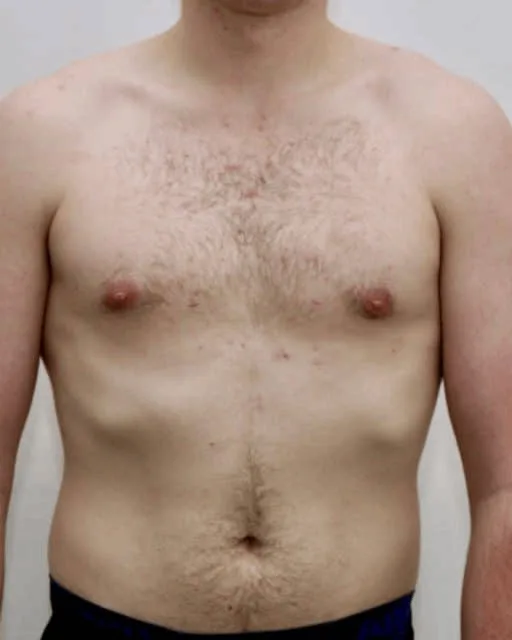
True gynecomastia means firm glandular tissue; pseudogynecomastia means only fat. You can feel the difference yourself. Lie on your back, pinch the tissue behind the nipple between thumb and finger, and compare it with the fat on the side of your chest. A rubbery, disc-shaped lump that moves as one piece is gland. Soft tissue that feels like the rest of your chest is fat.

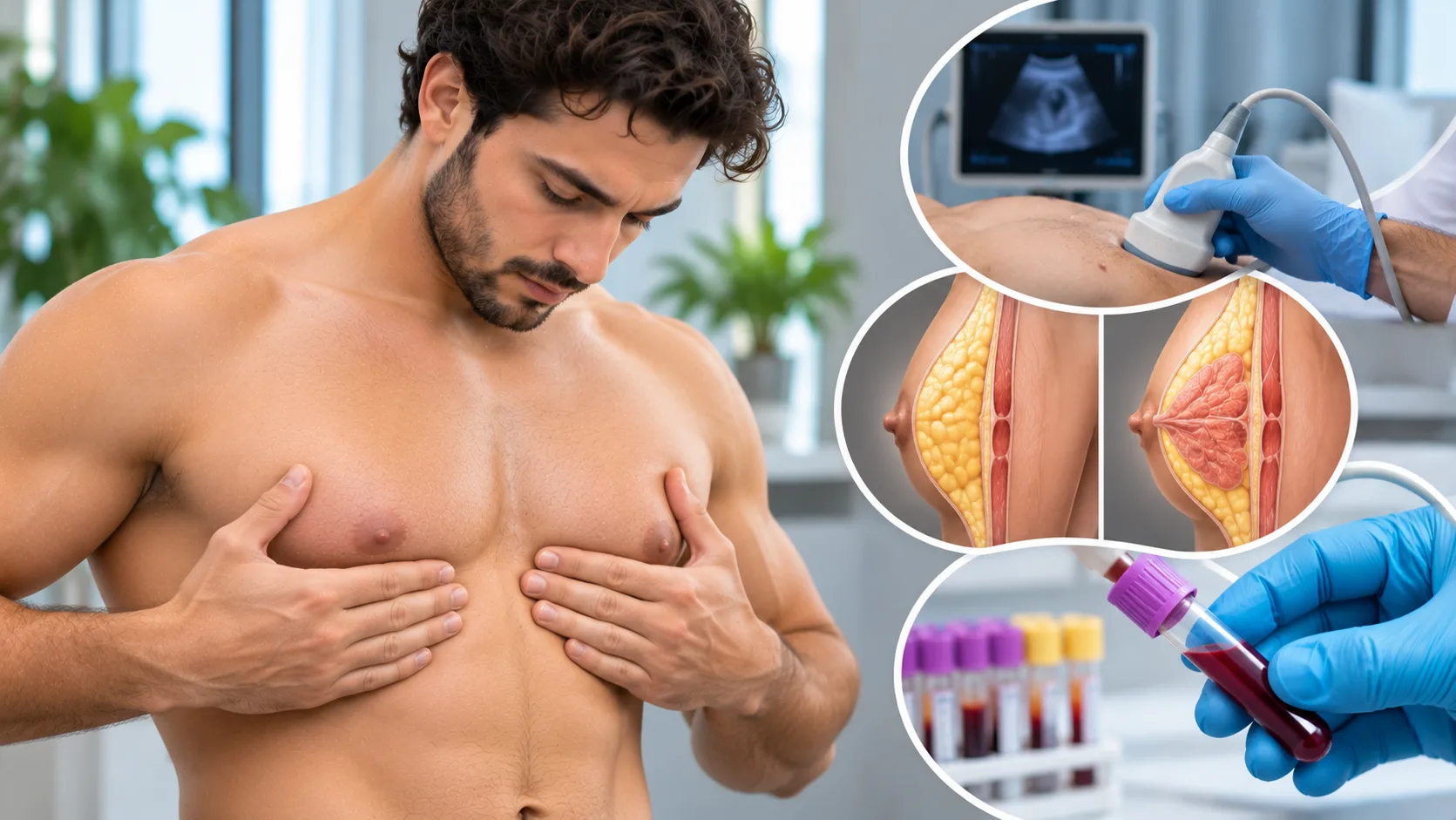
Why does this matter? Because fat responds to liposuction and gland does not. VASER liposuction alone works for pseudogynecomastia. True gynecomastia needs gland excision, otherwise a firm, puffy nipple remains after surgery. In our experience, most men who believe they have only fat actually have a mix of both. The surgeon confirms this by examining you on day 0 in Istanbul, and with an ultrasound scan if there is any doubt.

Feature True gynecomastia Pseudogynecomastia
What is enlarged Glandular breast tissue plus fat Fat only
Feel Firm, rubbery disc under the nipple Soft, like the rest of the chest
Nipple Often puffy or pointed Flat, normal
Responds to weight loss Partly: the fat shrinks, the gland stays Often yes
Treatment Gland excision plus VASER liposuction VASER liposuction alone
Package price in 2026 From $3,000 From $2,500

What are the gynecomastia grades?

Surgeons grade gynecomastia by how much tissue there is and whether the skin has stretched. The classic Simon classification from 1973 has 4 levels (I, IIa, IIb and III). Most clinics, including ours, use a practical 4-grade scale that maps closely to it. Your grade decides the technique, the price and the recovery time, so it is the first thing our lead surgeon looks for in your photos.

Grade What you see Skin excess Typical technique at Gynecomastia Turkey Package price (2026)
Grade I Small, localised enlargement behind the nipple; the classic puffy nipple None VASER liposuction, or VASER plus gland excision if a disc is felt $2,500-3,000
Grade II Moderate enlargement across the whole chest; visible under a T-shirt None or minimal VASER plus gland excision (most popular) or Hi-Def VASER plus excision $3,000-3,500
Grade III Marked enlargement with early sagging; the chest resembles a small female breast Moderate VASER plus excision plus skin tightening with nipple repositioning $4,200
Grade IV Severe, pendulous breasts, often after major weight loss Significant Excision plus skin removal plus nipple repositioning; 1 night in hospital $4,200

The Simon scale splits grade II into IIa (no skin excess) and IIb (minor skin excess), which is where many borderline cases sit. In practice, most of our patients are grade I-II and need only small incisions. Grade III-IV cases need a longer scar but still fit into a 5-6 day trip. If you are unsure of your grade, send us 2 photos and the surgeon will tell you within 24 hours, free of charge.

Does gynecomastia go away on its own?

Pubertal gynecomastia goes away on its own in most boys within 1-3 years. Adult gynecomastia rarely does. Once the gland has been present for more than 12 months it becomes fibrous and permanent, which is why doctors stop waiting after that point. The NHS page on male breast reduction says the same: surgery is the only effective treatment for established gynecomastia.

Some men try to shrink the gland with testosterone, tamoxifen or aromatase inhibitors. These drugs can help in the first few months while the tissue is still active, and they are sometimes useful when a medication caused the problem. They do nothing for a long-standing gland. Fat loss helps pseudogynecomastia, but many lean men at 10% body fat still have a visible disc. Chest exercises build the muscle under the gland, which pushes it forward and can make it more obvious.

03

Who is a good candidate for gynecomastia surgery?

You are a good candidate for gynecomastia surgery if you are 18 or older, your chest has been enlarged for at least 12 months, your weight has been stable for 6 months and you are in good general health. The best results come in men within 10-15 kg of their target weight, with elastic skin, who understand that surgery removes gland and fat but does not build muscle. A good candidate typically:

  • Is over 18 (we operate on 16-17 year olds only with parental consent and a gland that has been stable for 2+ years)
  • Has had the enlargement for 12+ months with no change in size
  • Has kept a stable weight for 6+ months, within 10-15 kg of the target weight
  • Does not smoke, or can stop for 4 weeks before and 4 weeks after surgery
  • Has stopped anabolic steroids and prohormones for at least 3 months
  • Has no uncontrolled diabetes, heart, liver, kidney or bleeding disorder
  • Can wear a compression vest for 4-6 weeks and avoid chest training for 4-6 weeks
  • Has realistic expectations: a flat, natural chest, not a bodybuilder's pectorals

Who should not have gynecomastia surgery?

You should not have gynecomastia surgery, or should delay it, if the gland is still growing, if a hormone problem or a medication has not been dealt with, or if your health makes general anaesthesia risky. Our surgeons postpone or decline some assessments for these reasons, and we say so plainly rather than operate on a man who will not get a good result. The main reasons we postpone or decline:

  • Under 18 with a gland that is still changing in size
  • Gynecomastia that appeared in the last 6-12 months with no clear cause; we ask for hormone tests and, if needed, an ultrasound first
  • Active steroid, prohormone or SARM use
  • BMI over 35, because results are poorer and complication rates higher; we recommend weight loss first
  • Uncontrolled diabetes, high blood pressure or a heart condition
  • Blood-thinning medication that cannot be paused; we work with your own doctor on this
  • A breast lump that feels hard, irregular or one-sided, or any nipple discharge, which needs a cancer work-up before anything else
  • Expectations that surgery cannot meet; we will tell you if we believe the operation will disappoint you

Male breast cancer is rare, about 1% of all breast cancers, but it exists. A one-sided, hard, fixed lump, skin dimpling or bloody nipple discharge always gets an ultrasound and sometimes a biopsy before we discuss cosmetic surgery. Gynecomastia itself is almost always two-sided, soft to rubbery and centred under the nipple. The gland we remove is sent for histology (laboratory examination) in every case as routine.

04

Gynecomastia surgery techniques: which one is right for you?

There are 5 techniques for gynecomastia surgery, and the right one depends on your grade and on whether you have gland, fat or both. Most men get a combination of VASER liposuction and direct gland excision through a 2-4 cm incision at the edge of the areola. Below we explain each option, what it costs in 2026 and who it suits. The surgeon chooses the technique; the price list only tells you what each one costs.

VASER liposuction for gynecomastia

VASER is ultrasound-assisted liposuction. A thin probe emits ultrasound energy that liquefies fat before it is suctioned out, which is gentler on blood vessels and nerves than traditional liposuction. The surgeon works through 2 incisions of about 3-4 mm, one at the side of each chest fold, that fade to nearly invisible dots. A VASER liposuction gynecomastia procedure on its own takes about 1 hour and costs $2,500 all-inclusive.

Lipo-only suits grade I pseudogynecomastia, where there is no firm gland. It also prepares the field for gland excision in the combined technique, because the ultrasound loosens the gland from the surrounding fat and makes it easier to remove through a smaller cut. On its own, liposuction cannot remove gland tissue. If a surgeon offers lipo only when you can feel a disc under the nipple, expect a puffy nipple to remain.

Gland excision through a periareolar incision

Gland excision means removing the breast gland directly with a scalpel through a periareolar incision, a curved cut along the lower border of the areola, the darker skin around the nipple. The incision is usually 2-4 cm long and sits exactly on the colour change, so the scar blends in. The surgeon leaves a thin layer of tissue under the nipple so it does not sink in, a problem called the crater deformity.

Excision is the only way to remove true gynecomastia, and complete removal is what prevents the gland from growing back. Studies indexed on PubMed report revision rates between 2% and 10% across techniques, and nearly all revisions are for residual tissue rather than new growth. Our revision rate is under 1% because we remove the whole disc every time and check the result by hand before closing.

"We remove the gland completely in every case, and we check the chest by hand before we close. A surgeon who leaves 20% of the gland to save 10 minutes leaves the patient with a puffy nipple and a second operation. Taking it all out the first time is what prevents recurrence." - our lead surgeon

Combined VASER liposuction plus gland excision

The combined technique is the standard for grade I-II true gynecomastia and our most popular package at $3,000. The surgeon first uses VASER to remove fat across the whole chest and to feather the edges, then removes the gland through the periareolar incision. The operation takes about 1.5 hours. You get a flat chest with a smooth transition into the armpit and the upper abdomen, rather than a flat centre with a bulge around it.

Lipo alone leaves the gland; excision alone leaves a step in the contour where the gland was, with the surrounding fat untouched. Doing both solves both problems under a single anaesthetic. The combined approach is also what the American Society of Plastic Surgeons describes as the usual method for male breast reduction, and it accounts for the majority of our 5,000+ cases.

Hi-Def VASER sculpting

Hi-Def (high-definition) VASER is the combined technique plus selective fat removal along the borders of the pectoral muscle, the lower chest line and sometimes the upper abdomen. The aim is an athletic look: a visible lower pec line and definition at the sides. It takes about 2 hours and costs $3,500 all-inclusive, with 4 hotel nights and a lymphatic drainage massage included in the package.

Hi-Def suits men with a body fat of roughly 12-18% who train regularly and want the chest to match the rest of their physique. It is not a substitute for muscle; it reveals what is already there. If your body fat is above 20%, we usually recommend the standard combined package and a normal diet, because sculpted lines disappear under a fat layer and you would pay $500 more for no visible gain.

Skin tightening with nipple repositioning for grade III-IV

Grade III-IV gynecomastia needs skin removal as well as gland and fat removal. The surgeon removes a crescent or a doughnut of skin around the areola (a periareolar mastopexy), or in severe cases uses an incision in the chest fold and moves the nipple up on a pedicle, a stalk of tissue that keeps its blood supply. The procedure takes 2-2.5 hours, costs $4,200, and includes 1 night in hospital and 5 hotel nights.

The trade-off is a longer scar in exchange for a chest that is actually flat. We discuss this openly. A man with grade IV gynecomastia who insists on no scars will end up with loose, empty skin folds. Most of our grade III-IV patients are men who have lost 30-60 kg and would rather have a fine line in the chest fold than carry the skin for the rest of their lives.

Gynecomastia surgery techniques compared

Technique Best for Incisions Operation time Hospital stay Price 2026 (all-inclusive) Scar visibility
VASER liposuction only Grade I pseudogynecomastia (fat only) 2 x 3-4 mm at the chest fold About 1 hour Day surgery $2,500 Minimal
Gland excision only Small, firm gland with little fat 2-4 cm periareolar About 1 hour Day surgery Priced as combined, $3,000 Low, hidden at the areola border
VASER plus gland excision Grade I-II true gynecomastia; the majority of cases 2 x 3-4 mm plus 2-4 cm periareolar About 1.5 hours Day surgery $3,000 Low
Hi-Def VASER plus excision Athletic men with 12-18% body fat As above plus 2-4 extra 3 mm ports About 2 hours Day surgery $3,500 Low
Skin tightening plus nipple repositioning Grade III-IV, post-weight-loss chests Periareolar doughnut or chest-fold incision 2-2.5 hours 1 night $4,200 Moderate
Gynecomastia plus full-torso VASER Chest, abdomen and flanks in one session Multiple 3-4 mm ports About 3 hours 1 night $5,500 Low

Which one you need is decided by the surgeon, not by the price list; some men who ask for lipo only are advised to add gland excision once the surgeon has seen their photos. Read our breakdown of gynecomastia surgery cost by technique and grade to compare what each option includes.

05

How does your gynecomastia surgery trip to Istanbul work?

Your gynecomastia surgery trip to Istanbul takes 4-6 days from landing to flying home. You arrive on day 0, have your tests and consultation, have surgery on day 1, rest at the hotel with daily nurse visits on days 2-3, and fly home on day 3-4 (day 5-6 for grade III-IV). Everything except your flight is organised and paid for within the package, and a coordinator who speaks your language is reachable 24 hours a day.

The 4 steps in detail:

  1. Online assessment (today). Send 2 chest photos, front and side, on WhatsApp (+90 505 026 5581) or through our free online assessment form. Our lead surgeon reviews them personally, confirms your grade and technique, and you receive a fixed all-inclusive quote within 24 hours. There is no fee and no obligation.
  2. Booking and preparation (2-8 weeks before). You choose a date, pay a deposit and book your flight to Istanbul Airport (IST) or Sabiha Gokcen (SAW). We send a preparation checklist: stop smoking 4 weeks before, pause supplements and blood thinners as advised, and arrange 5-7 days off work.
  3. Your trip (4-6 days). Day 0: VIP transfer to a 5-star hotel, blood tests, ECG and a face-to-face consultation with your surgeon. Day 1: surgery at a JCI-accredited hospital under general anaesthesia, 1-2 hours, then rest in hospital or at the hotel. Days 2-3: nurse check-ups at the hotel and a dressing change. Day 3-4: final check, fit-to-fly letter and transfer to the airport.
  4. Recovery at home (weeks 1-12). Video follow-ups at weeks 1, 2, 4 and 8, lifetime WhatsApp access to the medical team, compression vest for 4-6 weeks, and a staged return to the gym. The final result shows at 3-6 months.

What should you prepare before you fly to Turkey?

Before you fly, you need 4 things: a passport valid for at least 6 months, a return flight, a completed preparation checklist and 5-7 days of time off. Many nationalities, including most of Europe, the UK, the USA and the Gulf states, enter Turkey visa-free for short stays, but check the current rules for your passport before you book. Then work through the medical checklist:

  • Stop smoking and all nicotine, including vapes, 4 weeks before surgery; nicotine narrows blood vessels and raises the risk of skin healing problems several times over.
  • Stop aspirin, ibuprofen, fish oil, vitamin E, ginkgo and other blood thinners 10-14 days before, unless your doctor says otherwise.
  • Stop anabolic steroids, prohormones and SARMs at least 3 months before; they can regrow the gland.
  • Tell us about every medication and every previous operation, including anaesthetic reactions.
  • Pack loose, front-opening shirts with buttons or a zip, slip-on shoes and your usual medications.
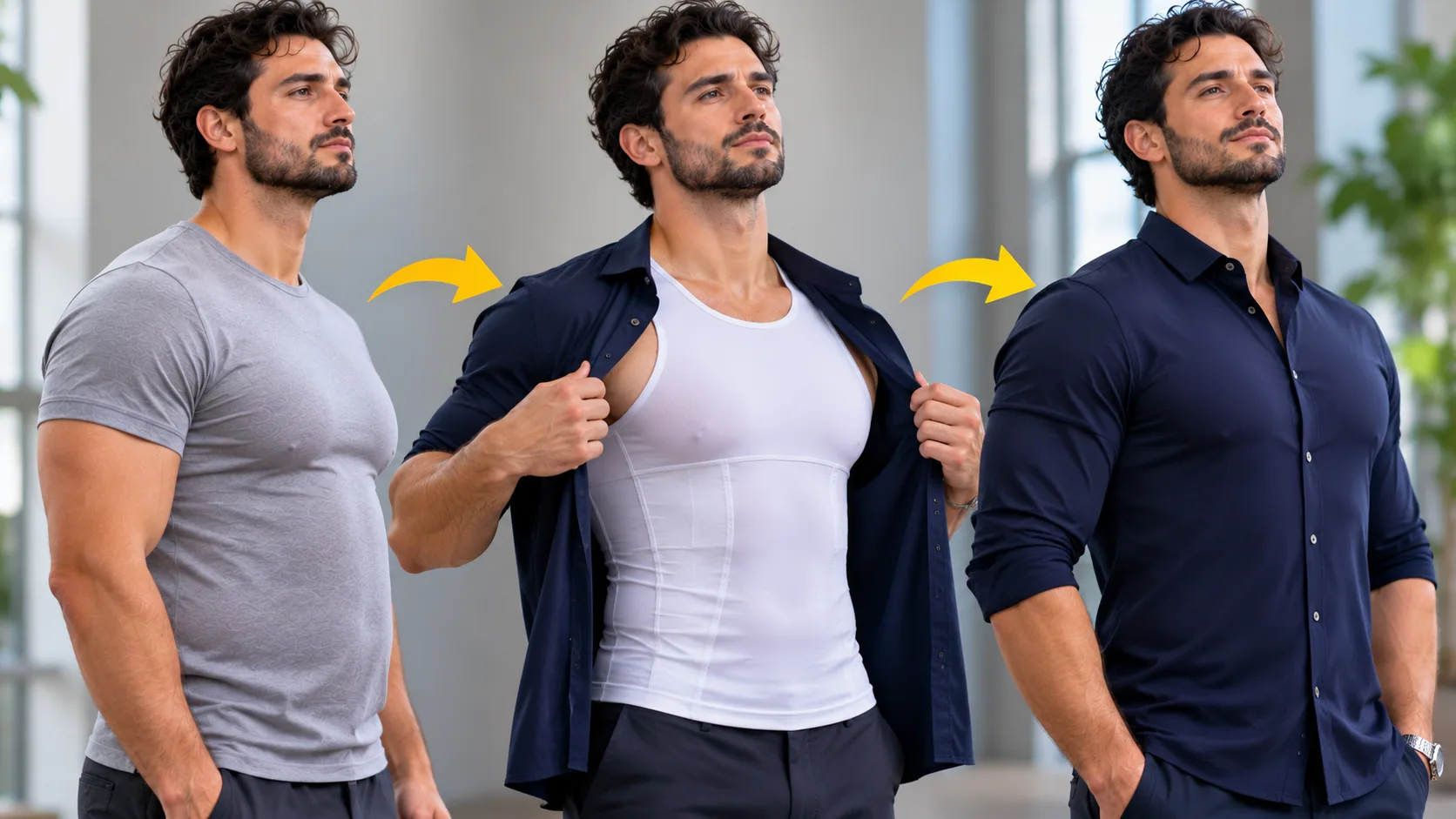
  • Plan a second compression vest for washing days; the first one is included in your package.
  • Arrange a lift from the airport at home; you should not drive for 7 days after general anaesthesia.
  • Plan light meals and 2-3 litres of water a day for the first week.
06

What happens on gynecomastia surgery day?

On surgery day you arrive at the hospital at around 8 am, meet the anaesthesiologist, have your chest marked while standing, and are asleep within an hour. The operation takes 1-2 hours. You wake in recovery already wearing your compression vest, spend 3-4 hours under observation, and return to the hotel by late afternoon, unless you are grade III-IV and stay 1 night. Your translator stays with you from arrival to discharge.

Anaesthesia: general or sedation?

We use general anaesthesia for almost every gynecomastia surgery. It is safer for the patient and the surgeon when a gland is being excised, because you are completely still and unaware. A board-certified anaesthesiologist is with you from start to finish. For grade I lipo-only cases we occasionally use sedation plus local anaesthetic, which means you are drowsy but breathing on your own and go home 2 hours earlier. You are asked not to eat for 6 hours and not to drink for 2 hours before surgery, and the anaesthesiologist checks your blood tests and ECG from day 0 before you are cleared.

Step by step in the operating room

  1. Marking (10 minutes). Standing up, the surgeon draws the gland outline, fat zones and incision lines with a skin marker and takes before photographs for your file.
  2. Anaesthesia (15 minutes). A cannula goes into the back of your hand; you are asleep within about 60 seconds.
  3. Tumescent infiltration (10 minutes). A fluid containing local anaesthetic and adrenaline is injected into the chest to numb the area and sharply reduce bleeding.
  4. VASER (20-30 minutes). The ultrasound probe liquefies fat, which is removed with fine cannulas through 3-4 mm ports.
  5. Gland excision (20-30 minutes). Through the periareolar incision, the gland is dissected out in one piece and sent for histology as routine.
  6. Contour check (5 minutes). The surgeon sits you up on the table, checks symmetry by eye and by hand, and refines any uneven zone.
  7. Closure (10 minutes). Fine dissolvable stitches inside, skin glue or tape on the surface. Drains are rarely needed with VASER; we use them in some grade III-IV cases for 24 hours.
  8. Compression vest on (5 minutes). You wake up already wearing it.

The first 24 hours after surgery

The first 24 hours are the hardest part, and they are usually easier than men expect. Expect a tight, bruised feeling, as if you did 200 push-ups, rather than sharp pain. Most patients rate it 3-4 out of 10 and manage with the tablets we provide. You can walk, eat and shower (with the vest off for 10 minutes) the next morning. The nurse visits your hotel on day 2 to check the dressings and answer questions. If one side of the chest swells noticeably more than the other, call us immediately, day or night.

07

Gynecomastia surgery results: what can you expect?

You can expect a flat, masculine chest with a natural contour, nipples that sit flat against the muscle and scars that fade to faint lines. You will see 60-70% of the result at 2 weeks once the first swelling settles, 85-90% at 6 weeks and the final result at 3-6 months. Our surgical team's revision rate is under 1%, and 98% of our patients report being satisfied with their outcome. Surgery does not build the pectoral muscle and does not stop fat from returning if you gain 15 kg; the aim is a chest that looks like it never had gynecomastia.

Results timeline

Timepoint What you see What you feel
Day 1 Chest already flatter but swollen; vest on Tightness, bruising, pain 3-4 out of 10
Week 1 Swelling peaks at days 3-5 then eases; bruising turns yellow Stiff and tired; desk work possible from day 5-7
Week 2 60-70% of the final shape visible; bruising mostly gone Mild tenderness; walking and lower-body gym allowed
Week 6 85-90% of the final shape; scars pink Normal daily life; chest training restarts
Month 3 Residual swelling gone in most men; scars fading Numbness around the nipple improving
Month 6 Final result; scars pale and flat Sensation back to normal in the large majority
Year 1 and beyond Stable as long as weight and hormones are stable Nothing to report

Gynecomastia surgery before and after: how to judge photos

Gynecomastia surgery before and after photos are the most honest proof a clinic can show you, if they are taken properly. Look for the same lighting, the same distance and the same pose (arms down, then arms up), and an after photo taken at 3 months or later, not at 2 weeks when swelling can hide a problem. Ask to see cases with your grade and your body type, not only the lean 25-year-olds.

Our before and after gallery shows real patients photographed on day 0 and at their 3-6 month video follow-up, with their permission. We include grade I to grade IV, lean and heavier men, and a few revision cases from other clinics so you can see what residual gland looks like. If a clinic only shows arms-up photos, be careful: raising the arms flattens the chest and hides sagging.

08

How much does gynecomastia surgery cost in 2026?

Gynecomastia surgery costs $2,500-5,500 all-inclusive at Gynecomastia Turkey in Istanbul in 2026. The same operation costs about $6,500-15,000 in the USA and GBP 5,000-12,000 in the UK, before any hotel or travel. The ASPS statistics put the average US surgeon fee alone at $4,800-5,600, with anaesthesia and facility fees added on top. The NHS puts private UK prices at GBP 3,500-6,500 plus consultations and garments, and it rarely funds the operation.

The gap is not about quality; it is about cost structure. A JCI hospital in Istanbul pays its staff in Turkish lira, rents and insurance are a fraction of US levels, and our surgeons operate on male chests every week, which spreads fixed costs. The Turkish government supports health tourism through USHAS and the Ministry of Health. Turkey treats 1.2-1.5 million international patients a year, and that volume keeps prices low without cutting corners on safety.

Gynecomastia surgery cost: Turkey vs USA vs UK

Item Gynecomastia Turkey, Istanbul USA (typical) UK (typical)
Surgeon fee Included $4,800-5,600 GBP 3,000-4,500
Anaesthesia plus hospital or facility fee Included $1,500-4,000 GBP 1,500-2,500
Compression vest, medications, tests Included $300-600 GBP 200-400
Hotel 3-5 nights, transfers, translator Included Not applicable Not applicable
Follow-ups 4 video calls plus lifetime WhatsApp Often charged separately Often charged separately
Total for VASER plus gland excision $3,000 About $8,000 About GBP 6,500
Total for grade III-IV with skin tightening $4,200 About $12,000 About GBP 9,500
NHS or insurance funding Not applicable Rarely, only with documented pain Rarely funded
All-inclusive gynecomastia packages in Istanbul
ProcedureUSAUKTurkeySave
VASER Liposuction Only(Grade I)$6,500£5,000$2,50062%
VASER + Gland Excision(Grade II)$8,000£6,500$3,00063%
Hi-Def VASER + Excision(Grade II)$10,000£8,000$3,50065%
Grade III-IV with Skin Tightening(Grade III-IV)$12,000£9,500$4,20065%
Gynecomastia + Full Torso VASER(Grade II)$15,000£12,000$5,50063%

The table below shows what men pay in 8 of the countries our patients fly from most often. The full list with 50+ countries, insurance notes and financing options is on our gynecomastia surgery cost page, which we update every January and July with current exchange rates.

Gynecomastia surgery cost by country

Published private clinic prices in 62 countries, compared with our all-inclusive Istanbul packages.

Gynecomastia surgery prices by country compared with Turkey
CountryTypical price rangeAveragevs. TurkeyYour savingsSources
SwitzerlandCHF 6,000 - CHF 14,000$7,282 - $16,992CHF 9,500$3,000 74% / $8,530
New ZealandNZ$12,000 - NZ$25,000$6,797 - $14,160NZ$19,000$3,000 72% / $7,762
United States$5,000 - $12,000$8,000$3,000 63% / $5,000
United Kingdom£3,500 - £8,000$4,667 - $10,668£5,500$3,000 59% / $4,334
AustraliaA$6,000 - A$16,000$4,175 - $11,133A$10,500$3,000 59% / $4,306
SingaporeSGD 4,000 - SGD 14,000$3,127 - $10,944SGD 8,500$3,000 55% / $3,644
QatarQAR 15,000 - QAR 35,000$4,121 - $9,615QAR 24,000$3,000 54% / $3,593
Israel₪12,000 - ₪30,000$3,878 - $9,696₪20,000$3,000 54% / $3,464

Sources: published prices from private clinics, national surgeon associations and price-comparison portals. Local prices usually exclude anaesthesia, facility fees, garments and follow-up visits. Our Turkey price is a complete package. Prices last reviewed: October 2026.

What is included in the all-inclusive price?

Every Gynecomastia Turkey package includes the surgery itself at a JCI-accredited hospital, 3-5 nights in a 5-star hotel, VIP transfers, a personal translator, a compression vest, all medications, pre-op tests, daily nurse check-ups and 4 video follow-ups with lifetime WhatsApp aftercare. Flights are not included. In full:

  • Surgery at a JCI-accredited private hospital in Istanbul: surgeon, board-certified anaesthesiologist, operating theatre and recovery room
  • 1 night in hospital for grade III-IV and full-torso packages
  • 3-5 nights in a 5-star hotel in Etiler, breakfast included
  • VIP transfers: airport to hotel, hotel to hospital and back, hotel to airport
  • Personal translator for the consultation, the hospital and the follow-up visits
  • Medical-grade compression vest, worn for 4-6 weeks
  • All medications: antibiotics, painkillers and anti-swelling tablets
  • Pre-op blood tests, ECG and histology of the removed gland
  • Daily nurse check-ups at the hotel on days 2-3
  • Video follow-ups at weeks 1, 2, 4 and 8, then lifetime WhatsApp aftercare
  • Not included: flights, travel insurance, personal expenses and any extra hotel nights you choose to add

The price you receive after your photo assessment is fixed. It does not change on arrival, and there is no surcharge because the surgeon found more tissue, since the surgeon has already seen your photos. The only situation in which a price changes is if you decide to add a second procedure, such as torso liposuction, after your consultation on day 0.

How much can you save compared with surgery at home?

Use the calculator below to compare the all-inclusive Istanbul price with a typical quote in your country. Most men from the USA save $4,000-9,500, men from the UK save GBP 3,000-7,500, and the saving is larger for Hi-Def and grade III-IV procedures, where home prices climb above $10,000. Even after a return flight and travel insurance, the difference usually covers a second trip a year later just to enjoy Istanbul.

Gynecomastia cost calculator

Compare what you would pay at home with our all-inclusive Istanbul package.

Gynecomastia grade Not sure? Pick the closest description.

Travelling with a companion

Companion stays free in the same room.

Show prices in

Your estimate

Typical price at home (In United States)

$5,000 - $12,000

All-inclusive Istanbul package

$3,000

You save

$5,000 (63% cheaper)

Not included: flights (typically $850 return)

  • Your Istanbul package includes
  • Surgery at a JCI-accredited hospital (surgeon + anaesthesiologist)
  • 3 nights in a 5-star hotel
  • VIP airport, hotel and hospital transfers
  • Personal translator
  • Medical compression vest
  • All medications, blood tests and ECG

Home-country figures are market averages from published clinic prices and may not include anaesthesia, hospital fees, garments or follow-ups. Turkey prices are our actual package prices.

Get your free surgical assessment

No obligation. Your photos are deleted on request.

09

Why do men choose Turkey for gynecomastia surgery?

Men choose gynecomastia surgery in Turkey for 3 reasons: the price is 60-70% lower than at home, the surgeons are high-volume specialists, and Istanbul has one of the highest concentrations of JCI-accredited hospitals outside the USA, with 40+ accredited hospitals nationwide. Turkey receives 1.2-1.5 million international patients a year, and male chest surgery is one of the fastest-growing procedures among them. Volume matters: repetition is what makes the contour check reliable, the gland excision complete and the complication rate low.

5,000+
Gynecomastia surgeries
50+
Patient countries
98%
Satisfaction
4.9/5
Google rating
<1%
Revision rate
24h
Reply time

Is gynecomastia surgery in Turkey safe?

Yes, gynecomastia surgery in Turkey is safe when you choose a board-certified plastic surgeon who operates in a JCI-accredited hospital licensed by the Ministry of Health for international patients. JCI accreditation means the hospital meets the same patient-safety standards that are audited in US hospitals: infection control, anaesthesia protocols, emergency care and sterilisation. The risk is not the country; it is choosing a cheap clinic that uses an unlicensed operator in a small private office.

How to check any clinic in Turkey, including ours:

  • The surgeon's name appears on the register of the Turkish Society of Plastic, Reconstructive and Aesthetic Surgeons, and ideally on the ISAPS and EBOPRAS member lists
  • Surgery happens in a named hospital with JCI accreditation that you can find in the JCI directory, not in an office
  • The hospital holds a Ministry of Health international patient licence
  • You speak to the operating surgeon, by video, before you pay a deposit
  • Prices are fixed and written, with every inclusion listed
  • Before and after photos show the clinic's own patients, with consistent lighting and 3-month results
  • Aftercare is defined: who you call, how fast they answer and what happens if there is a complication

More detail on safety, regulation and how to vet a clinic is in our guide to gynecomastia surgery in Turkey, including the questions we think every patient should ask before paying anyone a deposit.

Why Gynecomastia Turkey?

Gynecomastia Turkey in Etiler, Istanbul, has focused on male chest surgery for more than 15 years. Our surgical team has completed 5,000+ gynecomastia procedures for patients from 50+ countries, with 98% satisfaction, a 4.9/5 average rating and a revision rate under 1%. Every surgeon is board-certified in plastic, reconstructive and aesthetic surgery and a member of ISAPS, EBOPRAS and the Turkish Society of Plastic, Reconstructive and Aesthetic Surgeons. What sets us apart:

  • Male chest is our specialty, not one item on a 40-procedure menu; 5,000+ procedures over 15+ years is more than 6 a week on average
  • Complete gland excision in every true gynecomastia case; revision rate under 1% versus 2-10% in published series
  • Fixed all-inclusive pricing from $2,500, reviewed by the surgeon before you receive it
  • JCI-accredited hospitals only, with a board-certified anaesthesiologist at every operation
  • A reply to every assessment within 24 hours, in English and the main European and Middle Eastern languages
  • Structured aftercare: a nurse at your hotel, 4 video follow-ups and lifetime WhatsApp access
  • Honest selection: we postpone or decline when we do not think surgery will give you a good result

You can read each surgeon's certifications and memberships on our team page, and you can ask to speak with the surgeon who will operate on you before you commit to a date.

"Most of the revision cases I see from other clinics have the same problem: the gland was never fully removed, or liposuction was done alone on a man who clearly had a gland. The technique is not difficult. The discipline to do it properly every single time is what matters." - our lead surgeon

10

Gynecomastia surgery risks and complications: what should you know?

Gynecomastia surgery is a low-risk operation, but it is still surgery, and every patient should know the 8 main complications: hematoma (a collection of blood), seroma (a collection of fluid), infection, asymmetry, contour irregularity, changes in nipple sensation, visible scars and the need for revision. Across our 5,000+ cases the revision rate is under 1%, and most other complications are minor and settle with simple treatment at the hotel or at home.

We will never tell you that surgery carries no risk, that a result is certain or that recovery is pain-free. What we can say is that each risk has a known cause, a known rate in the medical literature and a known way to reduce it, and that we apply every one of those measures. The table below is the same one we go through with you on the day-0 consultation in Istanbul.

Complication rates and how they are treated

Complication Typical rate in published series What it is How it is treated
Hematoma 2-6% Blood collecting under the skin in the first 48 hours Compression and rest; drained under local anaesthetic if large
Seroma 3-10% Clear fluid collecting in the space where the gland was Needle aspiration at a follow-up, usually once
Infection 1-2% Redness, warmth and fever around an incision Oral antibiotics; rarely a wound wash-out
Nipple numbness Common at first; lasting in 5-10% Reduced feeling in the areola from stretched nerves Usually recovers over 3-12 months
Asymmetry needing correction 2-5% One side flatter or higher than the other Small touch-up under local anaesthetic at 6+ months
Contour irregularity or crater deformity 2-8% A dip under the nipple or a wavy surface Fat grafting or revision at 6+ months
Visible or thick scars 3-5% Raised, red or widened scar Silicone gel, tape, steroid injection if needed
Residual gland or recurrence 2-10% Firm tissue left behind, puffy nipple Revision excision

Published series vary a lot, and the ranges above come from reviews you can find on PubMed. Our own figures are internal audit numbers, not a peer-reviewed study, and we quote them as such. The difference between a 2% and a 10% revision rate is largely explained by whether the gland is excised completely, whether VASER or traditional lipo is used, whether compression starts in the operating room and how often the surgeon operates on male chests.

How do we reduce the risks?

  • We screen you twice: a photo review by the surgeon before quoting, then a face-to-face examination with blood tests and ECG on day 0
  • Surgery takes place in a JCI-accredited hospital with a board-certified anaesthesiologist and a full emergency team on site
  • Tumescent fluid with adrenaline sharply reduces bleeding, and VASER spares blood vessels better than traditional lipo
  • The gland is removed completely and the chest is checked by hand before closure
  • The compression vest goes on in the operating room and stays on for 4-6 weeks
  • Daily nurse checks at the hotel catch a hematoma or seroma within 24 hours
  • Video follow-ups at weeks 1, 2, 4 and 8 plus lifetime WhatsApp access mean a problem at home is seen the same day
  • If a complication needs hands-on treatment, we coordinate with a doctor near you, and if a revision is needed our own team performs it in Istanbul; ask for the written revision terms with your quote

Will gynecomastia come back after surgery?

Gynecomastia does not come back after surgery if the gland has been removed completely and your hormones and weight stay stable. The gland cannot regrow from nothing. Recurrence in published studies is almost always residual tissue that was left behind, and that is why we excise the whole disc rather than debulking it. The 3 things that can cause a new problem are anabolic steroids, large weight gain and a new hormone or medication issue. Fat that returns after a 15-20 kg gain is softer and more even than the original gynecomastia, and it responds to weight loss; steroids are the real threat, and we ask every patient to stay off them.

What does gynecomastia surgery feel like? Pain and downtime explained

Pain after gynecomastia surgery is usually mild to moderate, 3-4 out of 10 for 2-3 days, then a dull ache. Men describe it as the soreness after a heavy chest workout, with a tight feeling from the vest. You take the painkillers we provide for 3-5 days; most patients stop by day 5. Numbness around the nipple is normal and often lasts for weeks. Sharp, increasing pain with one-sided swelling is not normal and should be reported immediately, because it can be a hematoma.

11

Gynecomastia surgery recovery week by week

Gynecomastia surgery recovery takes about 6 weeks for daily life and 3-6 months for the final result. You can walk the same evening, fly home on day 3-4, go back to desk work in 5-7 days, train legs at 2 weeks and train chest at 4-6 weeks. The compression vest stays on for 4-6 weeks, and swelling settles in stages: 60-70% gone by week 2 and about 90% by week 6.

Recovery timeline table

Period What to do What to avoid Compression vest
Days 1-2 Walk around the room every 2 hours; shower on day 2; eat light meals Lifting, raising arms above the shoulders, alcohol, smoking 24 hours a day
Days 3-4 Fly home; short walks; dressing check by the nurse Carrying luggage over 5 kg; use a trolley 24 hours a day
Week 1 Desk work from day 5-7; daily 20-30 minute walks Driving for 7 days; sauna; sun on the scars 24 hours a day
Week 2 Lower-body gym, light cardio, cycling Chest, shoulder and back training; swimming 24 hours a day, off only to wash
Weeks 3-4 Upper-body machines at 50% weight, no chest isolation Bench press, push-ups, heavy pulling 24 hours a day, or 12 hours from week 4 if the surgeon agrees
Weeks 5-6 Full training returns gradually; swimming once scars have sealed Maximal lifts until week 8 Stop at 6 weeks
Months 2-6 Normal life; scar care with silicone gel; final photos at month 3-6 Sun on the scars for 12 months without SPF 50 None

When can you go back to the gym after gynecomastia surgery?

You can go back to the gym for lower-body training 2 weeks after gynecomastia surgery and start chest training at 4-6 weeks. Legs, light cardio and cycling at 2 weeks keep you active without stretching the chest. From week 3-4 you can add upper-body machines at about 50% of your usual weight. Bench press, push-ups and heavy rows wait until week 6, with maximal lifts from week 8.

The reason is simple. Training the chest early pumps blood into the area, which raises the risk of hematoma and seroma and prolongs swelling. It can also pull on the periareolar scar and widen it. Men who respect the 6-week rule get a tidier scar and a faster final result. The ones who bench on day 10 are the ones we see back on a video call with a seroma, which is avoidable.

Recovery checklist for the first 6 weeks

  • Wear the compression vest 24 hours a day for 4 weeks, then as advised until week 6
  • Sleep on your back, slightly propped up, for the first 2 weeks
  • Walk daily from day 1; do not lift more than 5 kg for 2 weeks
  • Shower from day 2; no baths, pools or sea for 3-4 weeks
  • Take all antibiotics as prescribed; painkillers only as needed
  • No smoking or nicotine for 4 weeks after surgery
  • Attend your 4 video follow-ups at weeks 1, 2, 4 and 8
  • Start silicone gel or tape on the scars at week 3 and continue for 3-6 months
  • Protect the scars from the sun with SPF 50 for 12 months
  • Message us on WhatsApp if you notice one-sided swelling, a fever above 38 C or increasing pain

Why do you wear a compression vest for 4-6 weeks?

The compression vest does 3 jobs: it presses the skin back onto the muscle so it reattaches smoothly, it reduces swelling and bruising, and it lowers the risk of fluid collecting in the space where the gland was. Four weeks of full-time wear is the minimum for the skin to reattach; 6 weeks gives the best contour, especially in men over 35 or with less elastic skin. The vest is included in your package, and most men buy a second one at home for washing days. It is thin, zips at the front and is invisible under a normal shirt at work.

Recovering at home after gynecomastia surgery abroad

Recovering at home after gynecomastia surgery abroad works well because the critical period is the first 72 hours, and you spend those in Istanbul with a nurse visiting daily. By the time you fly, the dressings have been checked, the vest is fitted and the risk of early bleeding has largely passed. At home you have video follow-ups at weeks 1, 2, 4 and 8, and you can send a photo on WhatsApp at any time; a member of the medical team replies the same day. A seroma or an infection at home is easy to diagnose from a photo and a short video call, and any local doctor can treat it; we write to your doctor if you want us to.

12

What do gynecomastia surgery scars look like?

Gynecomastia surgery scars are small and well hidden in most cases: two 3-4 mm dots at the chest fold from the VASER ports and a 2-4 cm curved line along the lower edge of the areola from the gland excision. At 12 months they are pale and flat, and most men cannot find them in a photograph. Grade III-IV cases have a longer scar around the areola or in the chest fold, which fades but remains visible on close inspection. Scar quality depends on where the incision is placed, how it is closed and what you do for the first 6 months; the first 2 are the surgeon's job and the third is yours.

Scar care that actually works

  • Keep the tape or glue on until it falls off (7-14 days); do not pick at it
  • Start silicone gel or silicone sheets at week 3 and use them for 3-6 months; this is the only scar treatment with strong evidence behind it
  • Massage the scar for 2-3 minutes twice a day from week 4 to soften it
  • No sun on the scars for 12 months, or SPF 50 every time; UV darkens scars permanently
  • No smoking; nicotine slows wound healing and widens scars
  • Do not stretch the chest with heavy pressing or wide push-ups for 6 weeks
  • If a scar becomes raised or itchy after 2-3 months, tell us; a steroid injection or a laser session can flatten it
  • Darker skin types (Fitzpatrick IV-VI) have a higher chance of pigmented scars, so we tailor the closure and the aftercare

"The periareolar scar is the price of a flat nipple. I place it exactly on the colour border, close it in two layers and never put tension on it. Done properly, by 1 year a patient has to search for it in the mirror." - our lead surgeon

13

What do patients say about gynecomastia surgery at Gynecomastia Turkey?

Our 4.9 out of 5 average rating comes from patients in 50+ countries, and 98% say they are satisfied with the result. The themes that come up most are the fixed price with no surprises on arrival, the daily nurse visits at the hotel, how quickly the chest looked normal, and the fact that the surgeon answered personally on WhatsApp after they got home. You can read the full set, including the critical ones, on our patient reviews page. The most common complaint is swelling that lasted longer than expected, usually in men who trained early or skipped the vest; the final result takes 3-6 months whatever anyone promises.

14

Pros and cons of gynecomastia surgery in Turkey

Gynecomastia surgery in Turkey saves most men 60-70% of the price at home, gets them a high-volume specialist and packages the whole trip into 4-6 days. The downsides are real too: a flight of 3-12 hours, follow-ups by video rather than in person, and a market that contains both excellent hospitals and poor clinics, which means you must do your homework before paying anyone.

Pros Cons
All-inclusive from $2,500, versus $6,500-15,000 in the USA A flight and 4-6 days away from home are required
Surgeons who operate on male chests every week Follow-ups after day 4 are by video, not in the clinic
JCI-accredited hospitals, 40+ in Turkey Quality varies widely between Turkish clinics; vetting is essential
A surgery date within weeks rather than months Standard travel insurance may not cover elective surgery abroad
Fixed written price, no surprise bills A complication at home needs a local doctor plus our coordination
Nurse at your hotel daily, translator, transfers Language and cultural differences, though translators bridge most of it
5-star hotel recovery can feel like a short break Flying 3-4 days after surgery needs planning: aisle seat, trolley, no heavy bags
Revision, if ever needed, by the same team that knows your case Legal recourse is in Turkey, not in your home country
15

How do you choose the best gynecomastia surgeon?

The best gynecomastia surgeon for you is a board-certified plastic surgeon who performs male chest surgery every week, operates in an accredited hospital, removes the gland completely, shows 3-month photos of his own patients at your grade and gives you a fixed written price. Titles and marketing matter less than volume, technique and honesty about risks. Work through this checklist with any clinic, including ours:

  1. Check board certification in plastic, reconstructive and aesthetic surgery, plus ISAPS or EBOPRAS membership.
  2. Ask how many gynecomastia procedures the surgeon performs per month; 20+ is a specialist, 2 is not.
  3. Ask whether the gland is excised in true gynecomastia; if the answer is that lipo is enough, walk away.
  4. Ask for before and after photos at 3-6 months, arms down, same lighting, at your grade.
  5. Confirm the hospital name and its accreditation, and search for it in the JCI directory.
  6. Speak with the surgeon on a video call before paying; a coordinator cannot answer medical questions.
  7. Get the price in writing with every inclusion listed, and ask what a revision would cost.
  8. Read reviews on independent platforms, not only on the clinic website, and look at how the clinic responds to criticism.

Our team page lists each surgeon's certifications and memberships, and our blog publishes research summaries on gynecomastia, recovery tips and patient stories. If anything on this page raises a question, send it to us on WhatsApp; a coordinator answers within 24 hours and the surgeon joins the conversation when a medical answer is needed.

16

Frequently asked questions about gynecomastia surgery

These are the 12 questions men ask us most often before booking gynecomastia surgery in Istanbul, answered as directly as we can. If your question is not here, send it to us with your 2 photos and we will answer it together with your fixed quote within 24 hours.

Frequently asked questions

Straight answers from our surgical team.

How much does gynecomastia surgery cost in Turkey?
Gynecomastia surgery in Turkey costs $2,500-5,500 all-inclusive at Gynecomastia Turkey in 2026: VASER liposuction alone $2,500, VASER plus gland excision (most popular) $3,000, Hi-Def VASER with excision $3,500, grade III-IV with skin tightening $4,200. The price covers hospital, surgeon, anaesthesia, hotel, transfers, translator, vest, medications and aftercare; flights are extra. Full cost comparison.
Is gynecomastia surgery in Turkey safe?
Yes, when it is performed by a board-certified plastic surgeon in a JCI-accredited hospital. Turkey has 40+ JCI-accredited hospitals and treats 1.2-1.5 million international patients a year. At Gynecomastia Turkey the revision rate is under 1% across 5,000+ cases and a board-certified anaesthesiologist attends every operation. Verify the surgeon's registration and the hospital's accreditation before paying.
How long does gynecomastia surgery take?
Gynecomastia surgery takes 1-2 hours under general anaesthesia. VASER liposuction alone takes about 1 hour, VASER plus gland excision about 1.5 hours, and grade III-IV surgery with skin tightening 2-2.5 hours. Including anaesthesia and recovery you spend 4-6 hours at the hospital, and most men return to the hotel the same afternoon. Grade III-IV patients stay 1 night.
Does gynecomastia surgery hurt?
Most men rate the pain 3-4 out of 10 for the first 2-3 days, more a tight, bruised feeling than sharp pain. You take the painkillers we provide for 3-5 days. Numbness around the nipples is normal and improves over weeks to months. Sharp, increasing one-sided pain with swelling is not normal and should be reported on WhatsApp straight away.
How long is gynecomastia surgery recovery?
You walk the same day, fly home on day 3-4, return to desk work in 5-7 days, train legs at 2 weeks and chest at 4-6 weeks. The compression vest is worn for 4-6 weeks. About 60-70% of the result is visible at 2 weeks, 90% at 6 weeks and the final result at 3-6 months.
Will gynecomastia come back after surgery?
No, not if the gland has been removed completely and your weight and hormones stay stable; the gland cannot regrow from nothing. Published recurrence of 2-10% is almost always residual tissue left behind. Our revision rate is under 1% because we excise the whole disc every time. Anabolic steroids or major weight gain can create a new problem, so we advise against both.
What is the difference between gynecomastia and chest fat?
Gynecomastia is firm glandular tissue; chest fat (pseudogynecomastia) is soft. Pinch behind the nipple: a rubbery, disc-shaped lump that moves as one piece is gland, while tissue that feels like the rest of your chest is fat. Fat responds to VASER liposuction alone ($2,500). Gland needs excision ($3,000 combined). Most men who think they have only fat have both.
What are the scars like after gynecomastia surgery?
Two 3-4 mm dots at the chest fold from the VASER ports and a 2-4 cm curved line along the lower edge of the areola, hidden by the colour change. Scars are pink at 6 weeks, pale and flat by 12 months. Grade III-IV surgery leaves a longer scar around the areola or in the chest fold, which fades but stays visible up close.
Can I fly home 3 days after gynecomastia surgery?
Yes. Most patients fly home on day 3-4 after a final check and a fit-to-fly letter. Book an aisle seat, use a luggage trolley, do not lift bags over 5 kg, walk every hour on flights over 3 hours and keep the compression vest on. Grade III-IV patients fly on day 5-6. Our driver takes you from the hotel to the airport.
Am I too young or too old for gynecomastia surgery?
We operate from age 18 (16-17 with parental consent and a gland that has been stable for 2+ years), and there is no upper age limit for healthy men. Pubertal gynecomastia often resolves within 1-3 years, so we advise teenagers to wait. Older men with less elastic skin may need skin tightening for a flat result, which costs $4,200 all-inclusive.
What is included in the all-inclusive package?
Surgery at a JCI-accredited hospital (surgeon, anaesthesiologist, hospital fees), 3-5 nights in a 5-star hotel, VIP transfers, a personal translator, a medical compression vest, all medications, pre-op blood tests and ECG, daily nurse check-ups at the hotel, video follow-ups at weeks 1, 2, 4 and 8, and lifetime WhatsApp aftercare. Flights, travel insurance and personal expenses are not included.
How do I get a quote for gynecomastia surgery?
Send 2 chest photos, one from the front and one from the side, on WhatsApp (+90 505 026 5581) or through our contact form. Our lead surgeon reviews them, confirms your grade and technique, and you receive a fixed all-inclusive quote within 24 hours. There is no fee, no obligation and no price change on arrival.
Still have questions? Ask a surgeon on WhatsApp

Get your free surgical assessment

Send two chest photos (front and side). A board-certified surgeon reviews them and you receive a personal plan and an exact all-inclusive price within 24 hours.

No obligation. Your photos are deleted on request. or call +90 505 026 5581

  1. 1.Send photos
  2. 2.Surgeon review
  3. 3.Fixed quote in 24h
All articles