
Getting Rid of Man Breast with Workouts: 8 Chest Exercises and Their Limits
Chest workouts can firm the muscle under the breast but cannot shrink breast gland. Learn the 8 best exercises, a 3-month test to tell fat from gland, and when to get assessed.
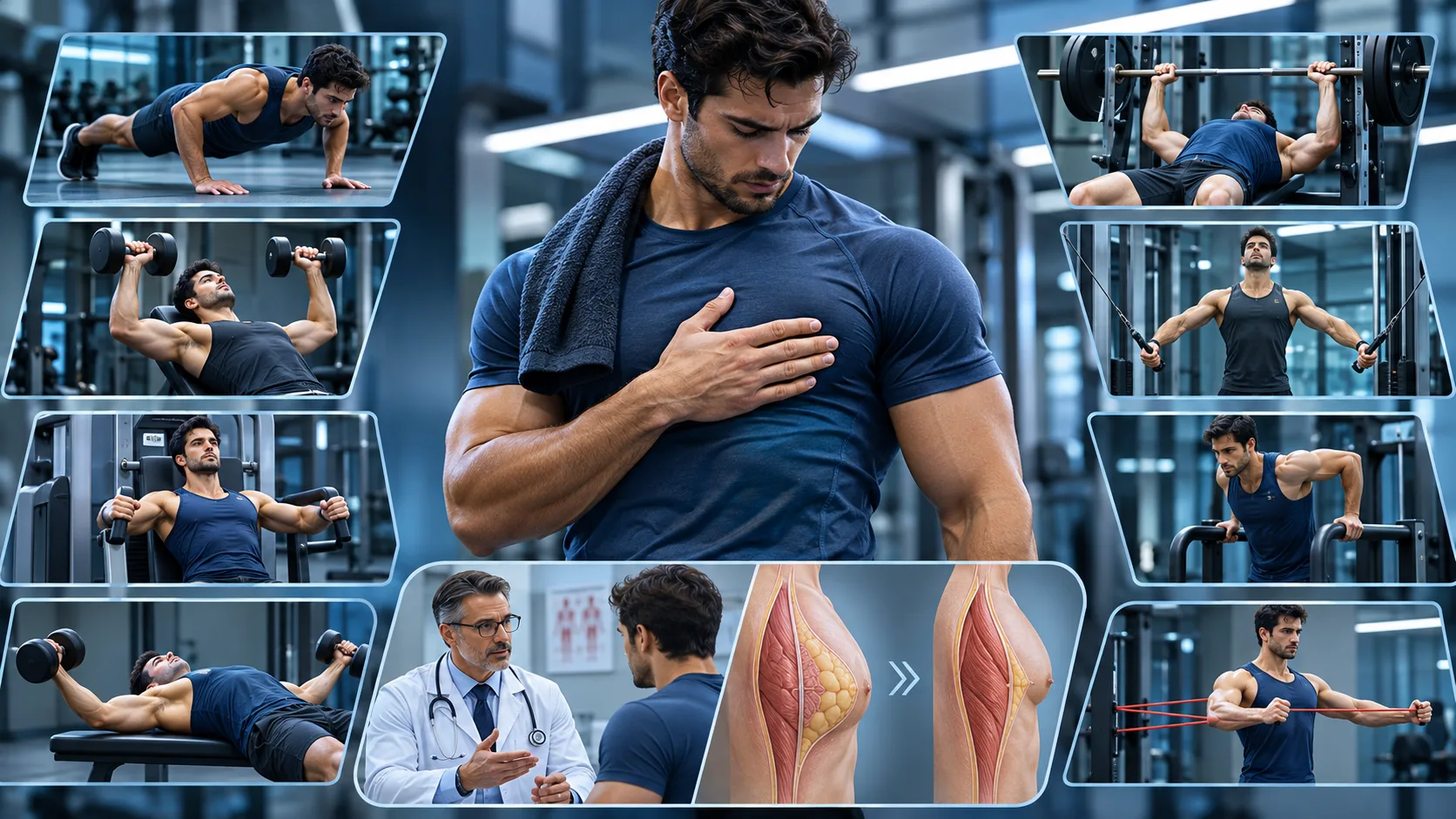
Getting rid of man breast with workouts can help some men, but only with part of the problem. Chest exercises build the pectoral muscles that sit beneath the breast. That can firm the chest and make a fat-based chest look flatter, but it cannot shrink breast gland, which is the most common cause of a firm, enlarged male chest. This guide covers the eight chest exercises worth doing, how to structure them, how long to give them, and the point at which training stops being the right answer. If you are comparing every route, our guide on how to get rid of man breasts ranks diet, exercise, pills and surgery side by side.
Key takeaways
- Chest exercises build the muscle under the breast. They cannot shrink glandular tissue.
- Fat-based chest enlargement (pseudogynecomastia) often improves with chest training combined with overall fat loss.
- Eight exercises cover the full chest. Two or three sessions a week, with the load increasing over time, is a sensible starting point.
- Give consistent training about 3 months. If a firm disc behind the nipple is still there, get it examined rather than training harder.
- If the enlargement is glandular, surgery is usually the reliable way to remove it, and no workout will replace that.
Can getting rid of man breast with workouts actually work?
Partly. Workouts can firm the chest and improve the look of a fat-based chest, but they cannot remove glandular breast tissue. Which of the two is causing your chest shape decides whether training is likely to be enough.
Gynecomastia, the medical term for enlarged male breast tissue, is common. It can appear during puberty, in older men, and in men taking certain medicines or using some drugs. The NEJM review by Braunstein describes hormone imbalance, medications, drug use and some medical conditions as the main causes. Excess body fat can also contribute, because fat tissue affects hormone balance.
Gland versus fat: why the cause matters
Two different tissues can produce a similar look. Gynecomastia is enlargement of the breast gland itself. Pseudogynecomastia is extra fat on a chest where the gland has not grown. The table below sets out the practical differences.
| Feature | Glandular (gynecomastia) | Fat-based (pseudogynecomastia) |
|---|---|---|
| What is enlarged | Breast gland tissue | Fat layer over the chest |
| Typical feel | Firm, rubbery disc under and around the nipple | Soft, even, no firm disc |
| Effect of weight loss | May reduce partly, not always | Often reduces as body fat falls |
| Effect of chest training | Firms the muscle underneath; gland unchanged | Firms the muscle; fat reduction still needed |
| Usual next step if it persists | Medical assessment; gland removal often needed | Assessment; liposuction is sometimes considered |
| Who confirms the type | A doctor or surgeon | A doctor or surgeon |
What exercise gets rid of man breast tissue? None directly
No exercise reduces breast gland. Push-ups, presses and flies work the muscles underneath the breast and the fat above it, but they do not act on the gland. Exercise helps in two indirect ways. It builds muscle that makes the chest look firmer, and regular activity supports the fat loss that can change a fat-based chest.
Men with more body fat sometimes see enlargement ease as they lose weight. This is not guaranteed, and it does not always resolve gland enlargement. If your weight has been stable or falling steadily and the chest has not changed, that is worth raising with a doctor.
How to self-check for a firm disc
Lie on your back with your arms relaxed. Using the flat pads of your fingers, press gently in small circles around the nipple and areola, moving outward. Compare one side with the other. Repeat once a month, at the same time of day and at a similar body weight, so the comparison is fair.
Fat usually feels soft and spread out. Gland often feels like a firm, rubbery disc sitting directly beneath the nipple, and it is often present on both sides. The check is rough, though. Some men with fat-based chests feel some firmness, and some men with glandular tissue feel very little. This self-check is not a diagnosis, and only an examination can tell the two apart.
The 3-month test: when to stop training and get checked
Here is a practical way to decide. Train consistently for 3 months, keep your weight stable or trending down, and check the disc monthly. Chest training builds the muscle beneath the breast. It does not change the gland itself.
So if a firm disc is still there after 3 months of consistent training and stable weight, it is more likely to be glandular than fat. That is the signal to book a proper assessment, not to train harder for another year.
See a doctor promptly if…
- You can feel a hard or fixed lump in the breast or chest.
- A lump on one side is growing or changing over a few weeks.
- You notice nipple discharge, including discharge with blood.
- The skin of the breast dimples or puckers.
- You have chest pain with breathlessness. Call emergency services now.
Exercises to get rid of man breasts: 8 chest workouts
Exercises for man breasts are, in practice, chest exercises. The aim is to build the pectoral muscles, work the upper, middle, lower and inner chest, and increase the load over time. The first four are good starting points if you are new to training. Pick three or four per session rather than doing all eight at once.
1. Push-ups
Push-ups are the simplest chest exercise, and they need only floor space. They work the middle chest, front shoulders and triceps. Keep your body in a straight line from head to heels, hands a little wider than shoulder width, and lower until your chest is close to the floor.
If you cannot manage around 8 controlled repetitions, raise your hands on a bench or kitchen counter. When you can do 15 clean repetitions, make them harder by slowing the lowering phase, raising your feet or wearing a weight vest.
2. Decline push-ups
Decline push-ups put your feet on a bench or sturdy step and your hands on the floor. The higher your feet, the more the load shifts toward the lower chest and shoulders. Start with a low step and build up gradually. Keep your neck neutral, and stop if you feel pain in the shoulder joint rather than muscular effort.
3. Flat dumbbell bench press
Lie on a flat bench with a dumbbell in each hand at chest level, palms facing forward. Press up until your arms are nearly straight without locking the elbows, then lower under control. Dumbbells let each side work independently, which helps correct imbalances, and they allow a more natural range of movement than a fixed bar.
Keep your shoulder blades pulled back and down, and keep your feet flat on the floor. Lower the weights until your elbows are just below the level of the bench. Go no deeper if your shoulders feel strained.
4. Incline dumbbell press
Set the bench to a modest incline, roughly 30 to 45 degrees, and press the dumbbells up from the upper chest. This emphasizes the upper chest, which many men feel is the most visible area under a shirt. Avoid very steep angles, because they move much of the work onto the front of the shoulders.
5. Dumbbell squeeze press
Hold two dumbbells together, pressing their inner faces against each other. Press up while keeping the dumbbells squeezed together throughout, then lower under control. The squeeze creates constant inward pressure on the chest and emphasizes the inner chest. It works well with lighter weights. Keep your elbows tucked rather than flared out to the sides.
6. Cable crossover
Set the pulleys at chest height or higher, step forward, and bring your hands together in front of your chest in a wide arc. Keep a slight bend in the elbows, pause briefly where your hands meet, then return slowly. Cables keep tension on the muscle through the whole movement. Avoid swinging your body to move heavier weight, because the chest should do the work.
7. Pec deck (machine fly)
The seated pec deck fixes the path of movement, which makes it a sensible choice for beginners learning to feel their chest working. Keep your back against the pad, bring the pads together in front of you with a controlled squeeze, and return slowly. Do not let the stack slam, because the lowering phase is part of the training stimulus.
8. Chest dips
Dips work the lower chest and triceps. Lean slightly forward, keep your elbows angled out a little, and lower until your shoulders are level with your elbows, no deeper. Then press back up. Dips are demanding on the shoulders, so skip them if you have shoulder problems. Use an assisted machine or a resistance band if you are not yet strong enough.
| # | Exercise | Main area | Equipment | Beginner option |
|---|---|---|---|---|
| 1 | Push-ups | Middle chest | None | Hands raised on a bench |
| 2 | Decline push-ups | Lower chest | Bench or step | Low step |
| 3 | Flat dumbbell bench press | Whole chest | Dumbbells, flat bench | Lighter weights |
| 4 | Incline dumbbell press | Upper chest | Adjustable bench | Shallower incline |
| 5 | Dumbbell squeeze press | Inner chest | Light dumbbells | Very light weight |
| 6 | Cable crossover | Inner and whole chest | Cable machine | Higher pulleys, lighter stack |
| 7 | Pec deck | Whole chest | Seated machine | Light stack |
| 8 | Chest dips | Lower chest, triceps | Dip bars or assisted machine | Assisted dips |
What workout gets rid of man breasts? A mix, not one move
There is no single best exercise. A combination works well: an incline dumbbell press for the upper chest, a flat press for overall chest development, and a fly variation such as the cable crossover or pec deck for the inner chest. The best exercises are the ones you can perform with good form, progress over time, and keep doing for months.
If you are choosing where to start, begin with push-ups, the incline dumbbell press and the pec deck. That covers the middle, upper and inner chest with a low learning curve.
How often should you do exercises for man breasts?
Most men do well with two or three chest sessions a week, with at least one rest day between them. Choose three or four exercises per session and do three sets of 8 to 15 repetitions, resting about 60 to 90 seconds between sets. Each set should end with one to three repetitions left in reserve, so your form stays strong.
Progress by adding repetitions first, then weight or difficulty. Record your sessions in a notebook or phone app so you can see the trend. Train your back as well, with rows or pull-downs, so the chest does not pull the shoulders forward over time.
| Session | Exercises | Sets and reps |
|---|---|---|
| Day 1 | Push-ups, flat dumbbell press, pec deck | 3 sets of 8 to 15 each |
| Day 3 | Incline dumbbell press, squeeze press, cable crossover | 3 sets of 8 to 15 each |
| Day 5 | Decline push-ups, chest dips or assisted dips, pec deck | 3 sets of 8 to 15 each |
Pair chest work with two or three sessions of cardio you can keep up, and eat in a way that supports gradual fat loss if body fat is part of your picture. These are general training principles, not a personal plan. Check with a doctor before starting a new program if you have heart, blood pressure or joint problems, or if you are returning from illness or injury.
How long do chest exercises take to show results?
Muscle changes slowly. Many men notice some firmness within weeks, but a visible change in chest shape usually takes months. The 3-month mark is the right point to judge.
| Timeframe | What training can change | What training cannot change |
|---|---|---|
| Weeks 1 to 4 | Learning form, mild soreness, better endurance | Breast gland, fat stores |
| Weeks 4 to 8 | Early firmness; better chest tone may be noticed | A firm disc behind the nipple |
| Weeks 8 to 12 | Visible muscle definition in many men, especially with fat loss | Gland size |
| Around 3 months | Time to recheck the disc and decide the next step | A medical examination |
| 6 months and beyond | Maintained results if training and weight stay consistent | Reversal of glandular enlargement |
These are typical patterns, not guarantees. Individual results depend on starting body fat, training consistency, sleep and nutrition.
How to track progress fairly
Judge change with the same conditions each time. Take a front and side photo once a week, in the same light, at the same time of day, standing in the same spot. Note your body weight and waist measurement too. A single photo taken in different lighting can make a chest look better or worse than it is, so trends across several weeks are more useful than any one image.
Pseudogynecomastia exercise: what helps when the chest is mostly fat
If your chest is fat-based, the best approach is the same chest plan combined with whole-body fat loss. Pseudogynecomastia responds to fat loss in a way that glandular tissue does not. The prefix 'pseudo' means that no gland has grown. The fat is what changes.
Why spot reduction does not work
Crunches and chest-specific exercises do not burn chest fat selectively. Fat leaves the body as a whole, and the order in which it leaves varies from person to person. A plan that targets only the chest usually disappoints, because the chest is just one area that stores fat.
What helps with a fat-based chest
- Create a sustainable calorie deficit through portion control and fewer calorie-dense drinks.
- Do regular cardio you can keep up, such as brisk walking, cycling or swimming.
- Keep training consistently. Muscle under the fat makes the chest look firmer as the fat decreases.
- Limit alcohol, which adds calories and can affect hormone balance.
- Protect your sleep and manage stress, since poor sleep is linked with appetite and weight gain.
For a food-by-food look at which everyday choices may work against you, read our guide to foods that cause man breasts, which also covers what to eat instead.
If steady fat loss continues for several months and the chest does not change at all, the cause may be glandular. That brings you back to the 3-month test and to a proper examination.
When chest training is not enough: options by cause
Exercise is a sensible first step for many men, but it has limits. If the disc persists after 3 months, or if the chest is clearly enlarged with glandular tissue, the options change. A doctor or surgeon will usually grade the chest before recommending treatment.
The Simon classification is a widely used grading system. It describes how much enlargement and how much excess skin are present, which helps a surgeon plan the procedure.
| Simon grade | General appearance | Usual approach (a surgeon decides after examination) |
|---|---|---|
| I | Small enlargement, mostly around the areola, little or no excess skin | Liposuction if fat-based; gland removal if glandular |
| II | Moderate enlargement, breast larger than the areola, usually little excess skin | Gland removal, sometimes with liposuction |
| III | Marked enlargement with excess skin | Gland removal with skin tightening |
| IV | Marked enlargement with excess skin and sagging of the breast | Gland removal with skin tightening, often with nipple repositioning |
Surgery is a real operation with real risks, including bleeding, infection, changes in nipple sensation and an uneven result. The NHS overview of male breast reduction is a useful starting point for what surgery involves and what to ask before you decide.
Where gynecomastia surgery in Turkey fits
If training and weight control have not changed a firm disc after about 3 months, or if a surgeon has graded your chest as glandular, surgery is the option that treats the gland directly. Many men who reach that point look abroad, and Istanbul is one of the destinations they consider.
If you are considering gynecomastia surgery in Turkey, the packages and trip structure are set out below. Gynecomastia Turkey is based in Etiler, Istanbul, and performs surgery in JCI-accredited private hospitals in Istanbul and Ankara. Procedures are performed under general anesthesia and take 1 to 2 hours.
2026 packages (all-inclusive, flights excluded)
| Package | Best suited to | Price (USD) |
|---|---|---|
| VASER liposuction only | Grade I, pseudogynecomastia | $2,500 |
| VASER + gland excision | Grade I to II; the most popular package | $3,000 |
| Hi-Def VASER + excision | Men wanting a more sculpted chest contour (suitability confirmed at assessment) | $3,500 |
| Grade III to IV with skin tightening and nipple repositioning | Marked enlargement with excess skin; includes 1 hospital night | $4,200 |
| Gynecomastia + full-torso VASER | Gynecomastia plus liposuction across the torso | $5,500 |
What is included and how long the trip takes
Each package includes the surgery, anesthesiologist, hospital stay, 3 to 5 nights in a 5-star hotel, VIP transfers, a translator, a compression vest, medications, pre-operative tests, histology (laboratory examination of the removed tissue), nurse visits on days 2 and 3, video follow-ups at weeks 1, 2, 4 and 8, and lifetime WhatsApp aftercare.
A typical trip lasts 4 to 6 days. Most patients fly home on day 3 or 4. Grade III to IV patients usually fly home on day 5 or 6.
| Activity | Typical timing after surgery |
|---|---|
| Desk work | 5 to 7 days |
| Lower-body gym training | About 2 weeks |
| Chest training | 4 to 6 weeks |
| Compression vest | 4 to 6 weeks |
| Final result | 3 to 6 months |
These are the clinic's general timings and will vary between patients.
How to get a fixed quote
Send two photos, a front view and a side view, to WhatsApp at +90 505 026 5581 or by email to info@gynecomastiasurgeryturkey.com. A surgeon reviews them and returns a fixed quote within 24 hours. The assessment is free and carries no obligation. Because a photo cannot show everything, treat the quote as a starting point. Final grading and suitability are confirmed at consultation.
For comparison, the clinic's own estimates put typical home prices at about $8,000 in the USA and about £5,500 to £6,500 in the UK. These are the clinic's published estimates, not independent price surveys.
Candidacy and the clinic's own figures
The clinic generally treats candidates aged 18 or over who have had a stable weight for 6 months, have been off anabolic steroids or prohormones for at least 3 months, and have not smoked for 4 weeks before and after surgery. If you use any of these substances, talk to your own doctor. Do not stop or change any prescribed medication because of anything in this article.
The clinic reports its own internal figures: more than 5,000 procedures, a revision rate under 1%, 98% patient satisfaction, a 4.9 out of 5 rating, and patients from more than 50 countries. These come from an internal audit and have not been peer-reviewed.
Common mistakes that slow progress
The most common mistake is expecting training to shrink the gland. Chest exercises build muscle, which can firm and define the chest, but they do not reduce breast tissue. Judging the plan by the wrong measure leads to months of wasted effort.
Anabolic steroids, prohormones and unregulated supplements are recognized causes of gynecomastia, so they can make the problem worse rather than better. If you use any of them, speak to a doctor. Do not make changes to prescribed medication based on this article.
Other frequent errors include:
- Doing endless crunches in the hope of burning chest fat.
- Training to failure in every set, or every day, with poor sleep and no rest.
- Skipping back training, which can leave the shoulders rounded.
- Comparing photos taken in different lighting or at different body weights.
- Waiting far beyond 3 months with a firm disc instead of getting it examined.
The bottom line
Getting rid of man breast with workouts is a sensible first step for a fat-based chest, and it builds a firmer, more defined chest either way. It cannot reduce breast gland. Give a consistent plan about 3 months, then recheck the disc and your photos. If a firm disc remains, a doctor or surgeon can tell you what is causing it and what to do next.
Frequently asked questions
Straight answers from our surgical team.
Can chest workouts alone get rid of man breasts?
What is the best exercise for man breasts?
How long do exercises for man breasts take to work?
What is pseudogynecomastia, and can exercise fix it?
How can I tell if my man boobs are fat or gland?
When should I consider gynecomastia surgery instead of training?
How much does gynecomastia surgery in Turkey cost?
Get your free surgical assessment
Send two chest photos (front and side). A board-certified surgeon reviews them and you receive a personal plan and an exact all-inclusive price within 24 hours.
No obligation. Your photos are deleted on request. or call +90 505 026 5581
- 1.Send photos
- 2.Surgeon review
- 3.Fixed quote in 24h
This guide is for educational purposes and does not replace a consultation with a qualified surgeon.
Related guides

Foods That Cause Man Breasts (and What to Eat Instead)
Most foods don't directly cause man breasts, but heavy drinking, ultra-processed food and extra body fat can add to chest fat. Here's what diet can and can't change.

How to Get Rid of Man Breasts: Every Option Ranked (Diet, Exercise, Pills, Surgery)
Diet and exercise can shrink chest fat, but only surgery removes gland. This guide ranks every option for man breasts, with honest notes on costs, timelines and risks.