
Gynecomastia vs Pseudogynecomastia Treatment: Liposuction, Gland Removal or Diet?
Gynecomastia is enlarged gland, pseudogynecomastia is excess fat. Learn how each is told apart, which treatments suit each, and what surgery in Istanbul costs.
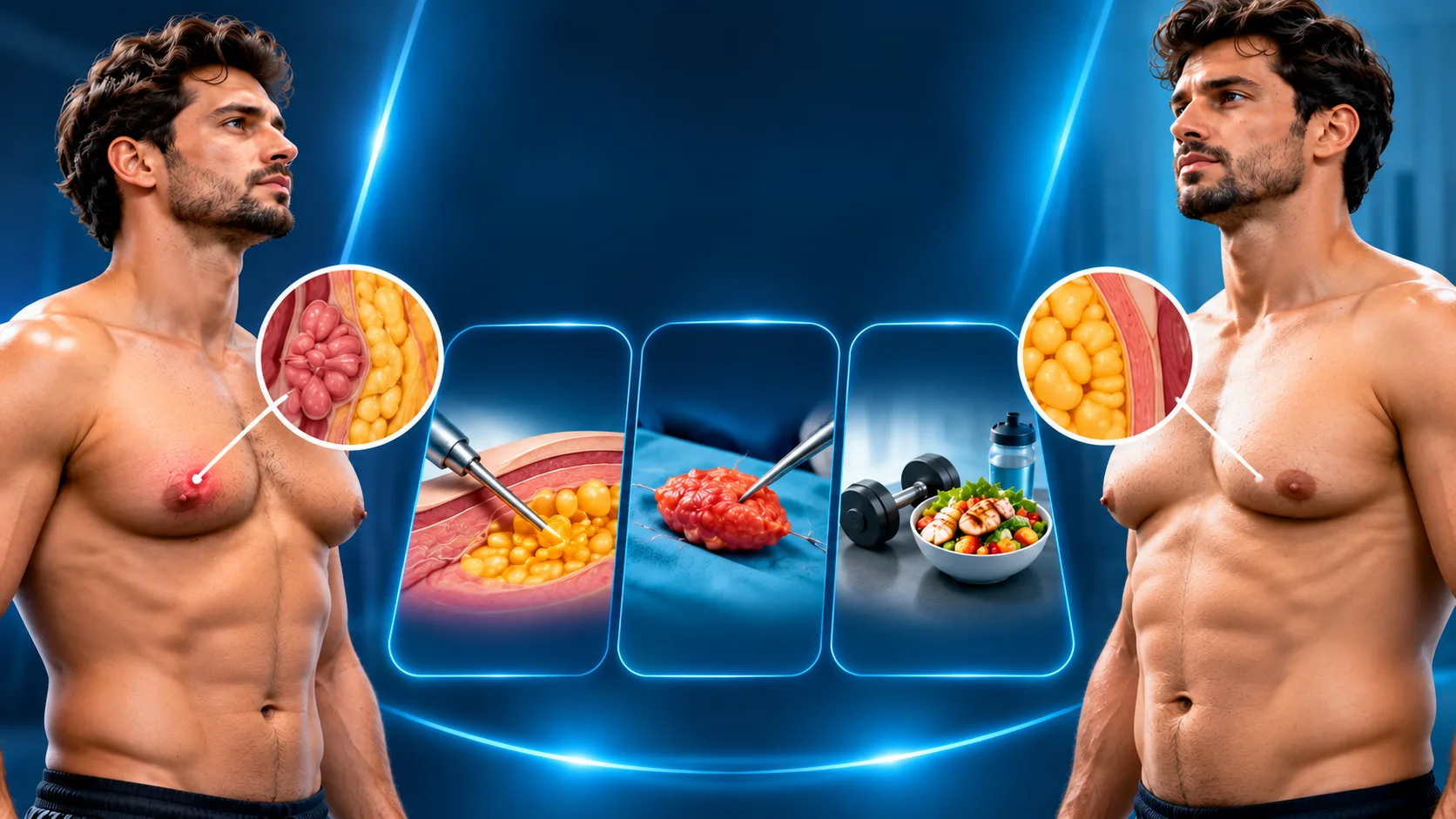
Gynecomastia vs pseudogynecomastia treatment comes down to one question: is the extra chest tissue mostly gland or mostly fat? Gynecomastia is an enlargement of glandular breast tissue, and it usually needs the gland removed surgically. Pseudogynecomastia is an enlargement caused by fat alone, and it is often treated with liposuction and changes to body composition. This guide explains how to tell the two apart, which treatments suit each one, and how to take the next step. If you are not yet sure which one you have, our guide to gynecomastia vs pseudogynecomastia is a good place to start.
Key takeaways
- Gynecomastia means enlarged glandular tissue. Pseudogynecomastia means excess fat with no increase in gland.
- Diet and exercise can reduce chest fat in many men, but they cannot remove glandular tissue or target the chest alone.
- Liposuction generally addresses fatty enlargement. Glandular tissue usually needs surgical excision, often combined with liposuction.
- A doctor or surgeon can usually tell the two apart through examination, and may order tests when the picture is unclear.
- Medicines, supplements and anabolic steroids can contribute to gynecomastia. Never stop a prescribed medicine without speaking to the doctor who prescribed it.
- Treatment depends on tissue type. Send two chest photos (front and side) to receive a surgeon-reviewed fixed quote within 24 hours, free and with no obligation.
What is the difference between gynecomastia and pseudogynecomastia?
Gynecomastia and pseudogynecomastia both produce a fuller, rounder chest, so they are easy to confuse in the mirror. The difference lies underneath. Gynecomastia involves an increase in glandular breast tissue directly behind the nipple and areola, while pseudogynecomastia involves an increase in fat across the chest, with no increase in gland.
The table below summarizes the main differences. These are general patterns, not a diagnosis. Individual chests vary, and some men have both tissues at once.
| Feature | True gynecomastia | Pseudogynecomastia |
|---|---|---|
| What is enlarged | Glandular breast tissue | Fatty tissue |
| Typical feel | Firm, rubbery, often disc-shaped behind the nipple | Soft, doughy, spread across the chest |
| Tenderness | Can be tender or sore, especially early on | Usually not tender |
| Typical location | Centred under the nipple and areola | Across the chest, often fuller lower down |
| Does weight loss remove it? | Not the gland itself, though fat around it may reduce | Often reduces, at least partly, with overall fat loss |
| Usual treatment | Gland removal, often with liposuction | Liposuction, and/or changes to body fat |
| Commonly linked to | Hormone balance changes, certain medicines, some health conditions | Body fat levels, weight gain, genetics, ageing |
How the two tissues feel
Glandular tissue usually feels firm and rubbery, and it often forms a disc-shaped area directly beneath the nipple. It can be tender or sore, particularly in the early stages. Fat feels soft and doughy, spreads across the chest without a firm disc, and is usually not tender. Some men notice the enlargement on one side only, which is worth mentioning to a doctor.
These descriptions are general. Only a clinician examining your chest can confirm which tissue is involved.
How a surgeon confirms the difference
A consultation usually starts with questions about when the change began, whether it has grown, your weight history, your medicines, supplements, alcohol use and any drug use. The examination then checks the feel and position of the tissue and whether there is extra skin. Where the picture is unclear, a doctor may order blood tests, such as hormone levels, thyroid function and liver and kidney function, or an ultrasound. After surgery, removed tissue is usually sent for histology, which examines it under a microscope to confirm what it was made of.
See a doctor promptly if…
- you find a hard or fixed lump in your chest or armpit
- a lump on one side is growing or changing
- you have nipple discharge or nipple bleeding
- the skin over the chest is dimpling or puckering
Chest pain with shortness of breath is an emergency. Call your local emergency number straight away.
Gynecomastia vs pseudogynecomastia causes and treatment: how they differ
Causes matter because they point toward the right treatment. Gynecomastia usually develops when the balance between estrogen and androgens (male hormones such as testosterone) shifts, or when breast tissue becomes more responsive to hormonal signals. A NEJM review by Braunstein groups the causes of gynecomastia into physiological, drug-related and disease-related categories.
What causes true gynecomastia
The most common patterns include:
- Normal life stages. Many newborn boys, teenagers going through puberty and some older men develop breast tissue enlargement as hormone levels change. In some cases it settles on its own over time.
- Medicines. Some prescription medicines are linked with breast tissue growth, including certain treatments for high blood pressure, prostate conditions and stomach problems. The list is long, so your prescriber is the right person to review your own situation.
- Anabolic steroids and other hormone products. Androgen-based products and so-called prohormones are a recognized cause of gland growth. Many are sold online with unclear or unlisted ingredients.
- Health conditions. Liver disease, kidney failure, thyroid problems, low testosterone and, rarely, tumours that produce hormones can all be involved.
If a medicine, supplement or substance may be involved, talk to the doctor who prescribed it or your GP. Do not stop, change or adjust a prescribed medicine on your own, because some conditions need careful medical management.
What causes pseudogynecomastia
Pseudogynecomastia is mainly about body fat. Weight gain usually adds fat across the body, including the chest, and genetics strongly influence where you store it. Ageing can also increase fat in the chest. Some men at a healthy overall weight still carry a fuller chest because their fat is concentrated there.
For a fuller look at symptoms and photos, read our guide to pseudogynecomastia causes and symptoms.
Causes compared
| Cause | Tissue most often involved | What it suggests for treatment |
|---|---|---|
| Hormone changes at puberty, in newborns or later in life | Gland | Often settles over time; persistent cases can be assessed by a doctor |
| Certain prescription medicines | Gland | Review with the prescriber; surgery may still be needed if gland persists |
| Anabolic steroids or prohormones | Gland | Discuss with a doctor. Our clinic requires being off these for at least 3 months before surgery |
| Liver, kidney, thyroid or hormone conditions | Gland | Medical workup comes first; surgery alone may not address the underlying cause |
| Excess body fat | Fat | Weight management, and possibly liposuction if fat is the main issue |
| Genetics and ageing | Fat or gland | Depends on tissue type, which an examination can establish |
Pseudogynecomastia treatment: what works and what does not
Pseudogynecomastia treatment focuses on reducing or removing fat. The most direct option is liposuction. Diet, exercise and body-composition changes can reduce chest fat in some men, but they cannot target the chest alone. Neither approach removes glandular tissue, so the first job is to confirm that the enlargement really is fat.
Weight loss and body composition
Losing body fat overall is the most reliable non-surgical approach, because chest fat is part of total body fat. You cannot choose where fat leaves your body. Many men see changes first in the face, abdomen and arms, and the chest may change more slowly. Slow, steady loss is also usually easier to keep off.
A practical starting point is a modest calorie deficit, adequate protein, regular sleep and daily activity, with progress checked every four weeks. Crash diets tend to be hard to sustain and can cause muscle loss, which does not help the chest look firmer.
Weight loss has one catch. As surrounding fat reduces, any underlying gland may become more noticeable. This is one reason an examination matters before you decide what to do.
Strength training and posture
Chest exercises such as presses, flyes and push-ups build the pectoral muscle beneath the tissue. Good posture and a stronger upper body can make a chest look flatter or more defined. However, muscle growth does not reduce fat or gland, so strength training is best seen as support for other treatment, not a cure. Resistance training two to four times a week, combined with regular cardio, is a widely recommended approach for overall body fat.
Liposuction for fatty chest enlargement
Liposuction removes fat through small incisions. The clinic uses VASER, an ultrasound-assisted technique in which ultrasound energy loosens fat before it is removed through a thin tube called a cannula. Liposuction suits fatty enlargement best, because fat can be removed without disturbing the gland.
Results develop gradually as swelling settles. The final result typically appears at 3 to 6 months. Skin elasticity matters: if the skin is loose, it may not fully tighten after fat removal. A surgeon can judge this from your examination and photos.
Liposuction alone will not remove a gland. If your enlargement contains gland, the surgeon may recommend removing it as well, as explained in the comparison below.
Be cautious with fat burners and testosterone boosters
Many products marketed for fat loss or male hormones are unregulated. Some contain stimulants or hormone-like ingredients that can affect the heart, the liver and hormone balance. Products sold to “boost testosterone” can disrupt hormones rather than help them. If a product is part of your routine, tell your doctor before you continue with it.
How to treat pseudogynecomastia: a step-by-step plan
If you suspect chest fat rather than gland, a sensible plan has six steps. The order matters, because the early steps may resolve the problem for some men.
- Get the tissue checked. Ask a doctor to examine your chest and confirm whether the enlargement is fat or gland.
- Review medicines, supplements and substances. Tell your doctor about all prescription medicines, over-the-counter products, supplements, and any anabolic steroids or hormone products. Do not change prescribed medicines without medical advice.
- Set a fat-loss plan you can sustain. Aim for gradual loss through diet and daily activity. A plan you can follow for six months usually works better than a short, strict one.
- Add resistance training. Work your chest, back and legs two to four times a week, and include regular cardio for overall fat loss.
- Track progress. Take photos in the same light every four weeks, and record your weight and waist measurement.
- Reassess after 3 to 6 months. If the chest is still noticeably enlarged after consistent effort, and you are otherwise a suitable candidate, a surgeon can discuss liposuction with you.
See a doctor promptly if…
- you notice a hard or fixed lump, or a lump on one side that is growing
- you have nipple discharge, bleeding or skin dimpling
Do not wait for the six-month review in these cases. Book an appointment now.
Pseudogynecomastia vs true gynecomastia treatment: a side-by-side comparison
True gynecomastia usually needs gland removal, while pseudogynecomastia is usually treated by removing fat. Some men have both, which is why many surgical plans combine liposuction with gland excision. The table below compares the options and shows the clinic’s 2026 package prices in US dollars. All packages are all-inclusive, and flights are excluded.
| Option | What it removes | Best suited to | Addresses gland? | Clinic price (2026) |
|---|---|---|---|---|
| Diet, exercise and medicine review | Fat, body-wide | Mild fatty enlargement, or enlargement linked to a factor that can be corrected | No | Your time and effort |
| VASER liposuction only | Fat | Pseudogynecomastia and grade I cases | No | $2,500 |
| VASER plus gland excision | Fat and gland | Grade I–II gynecomastia; our most popular package | Yes | $3,000 |
| Hi-Def VASER plus excision | Fat and gland, with more refined contouring | Men who want a more defined chest shape, subject to surgeon review | Yes | $3,500 |
| Grade III–IV with skin tightening and nipple repositioning | Gland, fat and excess skin | Marked enlargement with loose skin or nipple position concerns | Yes | $4,200 (one hospital night) |
| Gynecomastia plus full-torso VASER | Gland, chest fat and fat across the torso | Men with fat on both the chest and the torso | Yes | $5,500 |
Simon grades and what they mean
Surgeons often describe gynecomastia using the Simon classification, which grades the degree of glandular enlargement and the presence of extra skin. The grade helps predict how much treatment is likely to be needed, and whether skin tightening should be added. Purely fatty enlargement is not usually graded in the same way.
| Grade | General description | Typical surgical approach |
|---|---|---|
| I | Small enlargement, mainly around the areola, with little or no extra skin | Liposuction and/or gland excision through a small incision |
| II | Moderate enlargement that may extend beyond the areola, with variable skin excess | Gland excision with liposuction; skin tightening if needed |
| III | Marked enlargement with noticeable extra skin | Gland removal with skin excision; nipple repositioning may be considered |
| IV | The most advanced stage: pronounced enlargement, skin excess and sagging | Combined approach with skin tightening and nipple repositioning |
The clinic’s packages broadly follow these grades. Liposuction alone is designed for fatty enlargement and grade I cases. Gland excision suits grades I and II, and grades III and IV need skin tightening, which is why they require an additional hospital night. Your surgeon confirms the grade in person or from your photos.
Gynecomastia vs pseudogynecomastia treatment differences: recovery and results
The main treatment differences lie in how invasive the procedure is, where the incisions sit, how long recovery takes and what each treatment can fix. Liposuction alone generally uses small incisions and may allow a quicker return to normal activity. Gland excision involves a larger incision and removal of tissue, which can take longer to settle. Both usually involve a compression vest to help the skin adapt.
The timeline below applies to our treatments. Individual recovery varies, and your surgeon will confirm the plan for your procedure.
| Recovery milestone | Typical timing |
|---|---|
| Desk work | 5 to 7 days |
| Lower-body gym work | About 2 weeks |
| Chest training | 4 to 6 weeks |
| Compression vest | 4 to 6 weeks |
| Final result | 3 to 6 months |
The main differences between the two approaches are:
- Incisions. Liposuction uses small cuts. Gland excision uses a cut placed to remove tissue discreetly, and exact placement is a surgical decision made for each patient.
- Sensation. Changes in nipple or chest sensation can occur after either treatment, and they are more often associated with gland excision.
- Skin. If skin has lost elasticity, skin tightening may be needed. This lengthens recovery and makes the result more dependent on how the skin heals.
- What each can fix. Liposuction alone cannot refine a firm gland. Excision addresses the gland directly.
Risks, candidacy and who should wait
Any surgery carries risks. The NHS guidance on male breast reduction lists risks including bleeding, infection, scarring, asymmetry and changes in nipple sensation. Other possibilities include fluid collection under the skin, contour irregularities and the need for further surgery. A surgeon will explain your individual risks at consultation, and you should ask about them directly.
To be a suitable candidate for surgery at our clinic, you should meet these criteria:
- You are 18 or older. In rare cases, 16- and 17-year-olds may be considered with parental consent and a gland that has been stable for at least two years. If you are under 18, please speak to your doctor first, because hormones and body shape are still changing.
- Your weight has been stable for at least 6 months, because weight swings can change the result.
- You have been off steroids or prohormones for at least 3 months.
- You have not smoked for at least 4 weeks before surgery or for 4 weeks after it. Smoking slows healing and raises the risk of complications.
Meeting these criteria does not guarantee a suitable result. The surgeon makes the final decision after examining you.
Gynecomastia vs pseudogynecomastia treatment in Istanbul: packages and what is included
Gynecomastia Turkey is based in Etiler, Istanbul. Surgery takes place in JCI-accredited private hospitals in Istanbul and Ankara. You can read more about our service on our page for gynecomastia surgery in Turkey.
Each package is all-inclusive, with flights excluded. The 2026 packages are:
- VASER liposuction only (grade I or pseudogynecomastia): $2,500
- VASER plus gland excision (grade I–II, most popular): $3,000
- Hi-Def VASER plus excision: $3,500
- Grade III–IV with skin tightening or nipple repositioning: $4,200, including one hospital night
- Gynecomastia plus full-torso VASER: $5,500
Every package includes the surgery, an anesthesiologist, the hospital stay, three to five nights in a 5-star hotel, VIP transfers, a translator, a compression vest, medications, pre-operative tests, histology, nurse visits on days 2 and 3, video follow-ups at weeks 1, 2, 4 and 8, and lifetime WhatsApp aftercare.
For comparison, typical home prices quoted on our site are about $8,000 in the USA and £5,500 to £6,500 in the UK for chest surgery of this kind. Prices vary by surgeon, region and the work involved, so compare what is included, not just the headline figure.
Your trip at a glance
The trip usually lasts 4 to 6 days. Surgery itself takes 1 to 2 hours under general anesthesia, and most patients fly home on day 3 or 4. Grade III–IV patients usually fly home on day 5 or 6.
| Stage | What happens |
|---|---|
| Arrival and assessment | Consultation, pre-operative tests and a confirmed treatment plan |
| Surgery | 1 to 2 hours under general anesthesia in a JCI-accredited private hospital |
| Days 2 and 3 | Nurse visits to check healing |
| Flying home | Day 3 or 4 (grade III–IV: day 5 or 6) |
| Follow-up | Video consultations at weeks 1, 2, 4 and 8, plus lifetime WhatsApp aftercare |
Our clinic’s results, in context
Our internal audit records more than 5,000 procedures, a revision rate under 1%, a 98% patient satisfaction figure, a 4.9/5 rating and patients from more than 50 countries. These figures come from our own internal audit and have not been peer-reviewed, so please treat them as our own data rather than independent research.
To see how different chests have been treated, review our gynecomastia before and after photos. Individual results vary with tissue type, skin quality, healing and other factors, so photos are best used to understand the range of outcomes, not to predict your own.
Treatment depends on tissue type: get your free photo assessment
The fastest way to find out which treatment fits is to send two photos. Send a front photo and a side photo of your chest by WhatsApp to +90 505 026 5581, or by email to info@gynecomastiasurgeryturkey.com. A surgeon reviews them and returns a fixed quote within 24 hours. The service is free and carries no obligation.
For the most useful review, follow these tips:
- Stand in natural daylight, facing the camera, with your arms relaxed at your sides.
- Take a front photo and a side photo from about the same distance.
- Keep the frame to your chest and upper abdomen. You can crop your face out.
- Wear fitted clothing that shows your outline, or go shirtless.
- Avoid filters and heavy editing, which can hide the tissue shape the surgeon needs to see.
Photos help a surgeon estimate whether the enlargement looks mainly fatty or glandular, and whether there is extra skin. They cannot replace an in-person examination, and the final tissue type is confirmed by histology after surgery. If the photos suggest a different treatment would suit you better, the surgeon will tell you. You can then decide whether the timing, the plan and the trip work for you, with no pressure to book.
Frequently asked questions
Straight answers from our surgical team.
What is the main difference between gynecomastia and pseudogynecomastia treatment?
Can pseudogynecomastia be treated without surgery?
Does losing weight get rid of gynecomastia?
Is liposuction enough for pseudogynecomastia?
How much does gynecomastia vs pseudogynecomastia treatment cost in Istanbul?
How can I tell if my chest is fat or gland?
Get your free surgical assessment
Send two chest photos (front and side). A board-certified surgeon reviews them and you receive a personal plan and an exact all-inclusive price within 24 hours.
No obligation. Your photos are deleted on request. or call +90 505 026 5581
- 1.Send photos
- 2.Surgeon review
- 3.Fixed quote in 24h
This guide is for educational purposes and does not replace a consultation with a qualified surgeon.
Related guides

What Is Pseudogynecomastia? Causes, Symptoms & Pictures
Pseudogynecomastia means a chest that looks enlarged because of fat, not breast gland. Learn the causes, symptoms, examples, how it is diagnosed and treated, and how to get a free photo review.
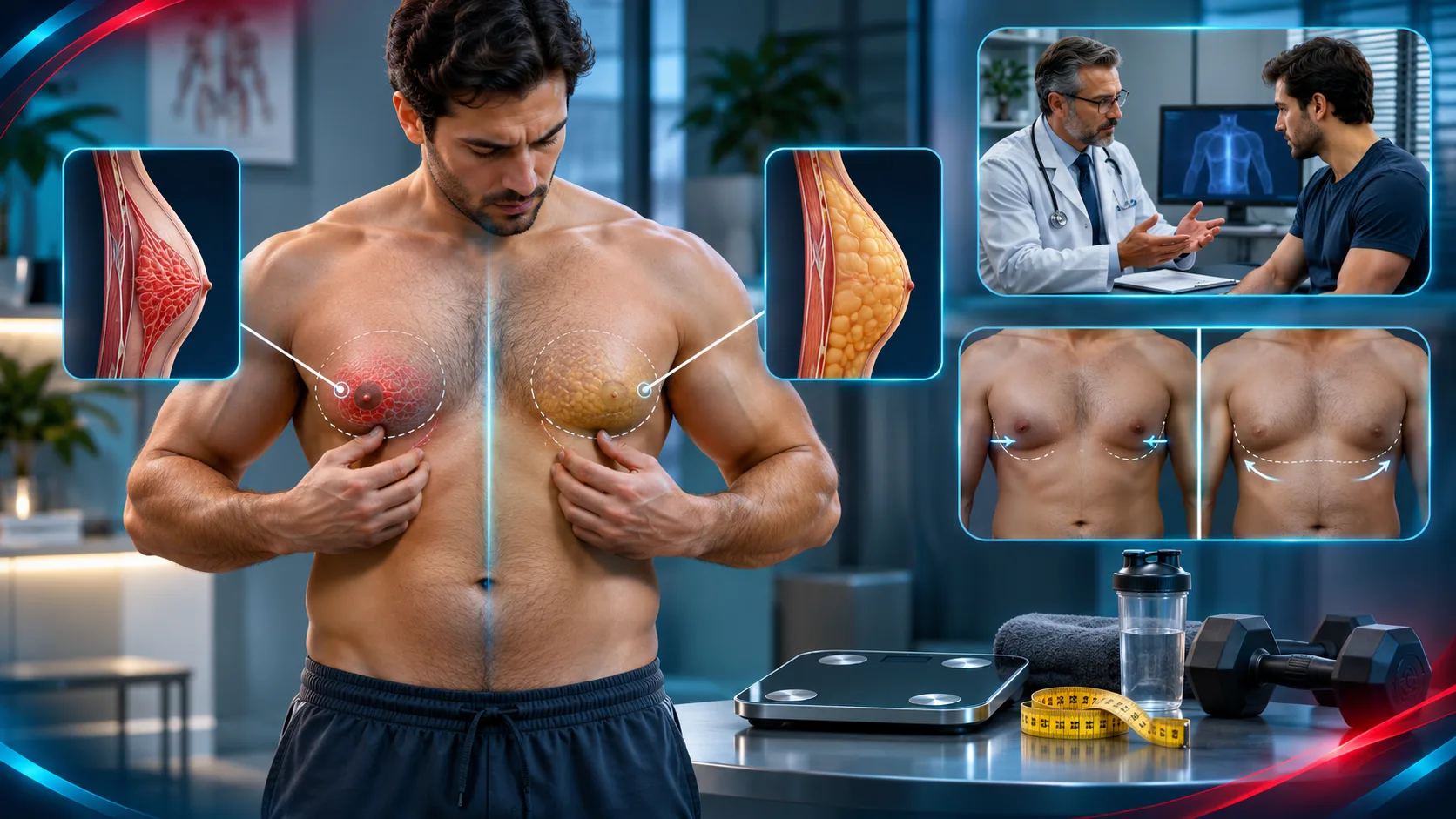
Gynecomastia vs Chest Fat: How to Tell the Difference (2027)
Gynecomastia vs chest fat comes down to one question: is there a firm disc of gland behind the nipple? This 2027 guide gives you a 5-step self-test, explains the causes of each, and shows which treatment actually works for gland, fat and mixed cases.