
What Is Pseudogynecomastia? Causes, Symptoms & Pictures
Pseudogynecomastia means a chest that looks enlarged because of fat, not breast gland. Learn the causes, symptoms, examples, how it is diagnosed and treated, and how to get a free photo review.

Pseudogynecomastia is a condition in which a man's chest looks enlarged or rounded because of extra fat, not because the breast gland has grown. The chest can look 'breast-like' from the front or side, yet there is no glandular tissue behind the nipple to remove. Because the two look so alike, many men are unsure which one they have. This guide explains the meaning of pseudogynecomastia, its common causes and symptoms, what typical examples look like, how clinicians tell fat from gland, and which treatments are used. For a side-by-side comparison, read our guide to gynecomastia vs pseudogynecomastia first. Pseudogynecomastia is usually not dangerous, but any hard or one-sided lump needs a doctor's review.
Key takeaways
Pseudogynecomastia is a chest that looks enlarged because of fat. The breast gland itself is not enlarged.
The term means 'false gynecomastia': the look is similar, but the tissue underneath is different.
Weight gain and where your body stores fat are common reasons. Age and low muscle tone can make fat more visible.
Fat feels soft and can be pinched. Glandular tissue usually feels firmer and sits under the nipple, so a clinical examination is the most reliable check.
Weight loss and strength training can reduce fat-based fullness, but they do not shrink glandular tissue.
Fat-only chests are often treated with VASER liposuction. A mix of fat and gland may also need gland removal.
What is pseudogynecomastia?
Pseudogynecomastia is a non-glandular enlargement of the male chest. Fat builds up in the layer under the skin and over the chest wall, which makes the chest look fuller, rounder or wider around the nipples, even though the breast gland is not enlarged. In plain terms, the shape is caused by fat, not by breast tissue.
Doctors use the term to separate a fat-based chest from true gynecomastia. Gynecomastia is the benign growth of glandular breast tissue in men. The two conditions can look similar in a mirror, but they behave differently and need different treatments. Losing weight can make fat-based fullness less obvious, but it does nothing to a gland. Liposuction removes fat, while a gland usually needs to be removed surgically.
Some clinicians also use the term lipomastia for this fat-based appearance. Pseudogynecomastia is not a disease in the everyday sense; it describes what the chest is made of. It is often linked with weight gain, and it can occur at any adult age. The fullness may affect one side or both, although fat-based changes are often roughly even on each side.
Pseudogynecomastia meaning: where the word comes from
The word is built from Greek and Latin parts. Pseudo- means false or apparent. Gyne (sometimes written gyneco-) means woman, and mast- means breast. The suffix -ia denotes a condition. Put together, the term describes an apparent or 'false' version of gynecomastia.
The name describes how the chest looks, not how it is made. A man with pseudogynecomastia has a chest that resembles gynecomastia, but the tissue behind the nipple is mainly fat rather than gland. That is why the term matters to clinicians, who need to know which tissue is causing the fullness before choosing a treatment.
You may see the word used loosely online to describe any fuller male chest. In everyday conversation people may say chest fat, pec fat or simply a puffy chest. These phrases are fine for describing how something looks, but a clinical diagnosis depends on what is actually under the skin.
Pseudogynecomastia vs gynecomastia: how to tell them apart
Pseudogynecomastia is caused by excess fat, while gynecomastia is caused by enlargement of the breast gland. The main way to tell them apart is by feel, which is why a physical examination matters more than appearance alone.
Feature | Pseudogynecomastia (fat) | Gynecomastia (gland) |
|---|---|---|
What is enlarged | Fat tissue | Breast gland tissue |
How it feels | Soft and diffuse; a fold can be pinched | Firm, rubbery disc, usually under the nipple |
Shape | Wider or fuller chest, often even on both sides | Rounded, puffy area centred on the nipple |
Tenderness | Usually none | Can be tender or sore, especially early on |
Typical links | Excess body fat, weight gain, fat distribution | Hormonal shifts (puberty, older age), some medicines, some medical conditions |
Nipple position | Usually unchanged | Usually unchanged in mild cases |
Usual approach | Weight loss, strength training, liposuction | Medical review, then gland removal; liposuction if fat is also present |
Many men have features of both. A clinician may find that most of the fullness is fat with a small glandular disc, or the reverse. Gynecomastia itself is common across male life stages, as a Mayo Clinic Proceedings review describes, although exact figures vary by age group.
Because the two can overlap, treat any self-assessment as a starting point rather than a final answer.
What are the causes of pseudogynecomastia?
Pseudogynecomastia is caused by an increase in fat in the chest. That fat is usually linked to overall body weight and to where your body stores fat. Several factors can contribute, and they often overlap, so there is rarely one single cause.
Excess body fat and weight gain
Weight gain is a common reason men notice a fuller chest. Fat is stored throughout the body, and the chest is one of the places it can accumulate. When overall body fat rises, the chest may look fuller even though the breast gland is unchanged. Some men notice the change first in photos, or because shirts fit differently.
Fat-based fullness can respond to sustained weight loss, although the chest does not always lose fat first or evenly. Results depend on your starting weight, how quickly you lose it, your age and your genetics.
Fat distribution and genetics
Where you store fat is partly inherited. Some men carry more fat across the chest, upper abdomen and flanks, while others store it mainly on the hips, thighs or lower abdomen. If male relatives have a similar chest shape, that can be a clue to a family pattern of fat storage. A chest that looks fuller at rest may simply reflect your natural build.
Age-related changes and low muscle tone
As men age, muscle mass often decreases and body fat tends to shift toward the trunk. Less muscle tone under the chest can make a small amount of fat look softer and more visible. Strength training can improve the shape of the chest by building the pectoral muscles beneath the fat, though it does not remove fat from that area by itself.
Hormones and why body fat matters
Fat tissue contains enzymes that convert some hormones into others, so excess body fat can shift the balance of hormones in the body. This is one reason doctors look at body fat and breast tissue together. Braunstein's review of gynecomastia in the New England Journal of Medicine describes obesity as a contributing factor to glandular enlargement in some men.
Other causes of true gynecomastia are different in kind. They include some medicines, the hormone changes of puberty or older age, and certain medical conditions. If you take a medicine that may affect breast tissue, talk to the prescriber. Do not stop or change a prescribed medicine on your own.
When fat and gland occur together
The two can coexist. A man may have fat-based fullness across the chest and a small glandular disc under one or both nipples. In that case, weight loss or liposuction may improve the overall contour, but the gland may still be noticeable. This is why a clinical examination is so valuable: it helps identify each component before a plan is made.
What are the symptoms of pseudogynecomastia?
Pseudogynecomastia usually causes a soft, full or rounded chest, often on both sides, without pain. Its symptoms are mostly about appearance and how clothes fit, rather than physical discomfort. Posture, clothing and weight changes can all alter how noticeable the fullness looks.
Common signs
The chest looks fuller or wider, especially at the sides and under the nipples.
The tissue feels soft and moves with the chest, and a fold can be pinched between finger and thumb.
When the fullness comes from overall body fat, it is often roughly even on both sides.
Most men have no pain or tenderness in the chest.
The nipple and areola usually keep their normal shape and position.
Shirts pull across the chest, or fitted clothing shows the outline.
The chest may look more noticeable after weight gain and less noticeable after weight loss.
How it can affect you
Some men describe the change as affecting confidence more than comfort. They may avoid removing a shirt at the beach or gym, or feel uneasy in photos. Those feelings are common and reasonable. Whether to treat the chest is a personal choice, and it is worth discussing the impact on your daily life with a clinician.
Symptoms that need checking
Pseudogynecomastia itself is not a warning sign. However, some chest changes can have other causes, and a few need prompt medical review. Any of the following should be checked by a doctor rather than assumed to be fat:
See a doctor promptly if you notice:
a hard or fixed lump in the chest or under the nipple
a lump on one side only that is growing
nipple discharge, or bleeding from the nipple
skin dimpling, puckering or other new skin changes over the chest
chest pain with shortness of breath: call emergency services straight away
These signs do not automatically mean a serious condition. They do mean an examination is needed, and a clinician can decide what further tests, if any, are required.
Pseudogynecomastia examples and pictures: what to look for
The examples below are illustrative descriptions, not patient stories. They are meant to help you compare what you see with common patterns. Pictures can help too, but a photo shows shape only, not what is under the skin.
Example 1: a fuller chest after weight gain
Picture a man in his thirties who has gained weight over several years. His chest looks wider and softer, the area around his nipples blends into the surrounding skin, and there is no firm lump. When he pinches a fold of tissue at the side of his chest, it is soft, thick and moves easily. This pattern is often seen in pseudogynecomastia.
Example 2: a soft chest with a firm area under one nipple
Now picture a man whose chest is full all over, but who notices a small firm disc under one nipple. This is a mixed picture. The fat may account for most of the fullness, while the glandular part needs assessment. A firm area that is new, one-sided or growing should be checked by a doctor promptly, rather than assumed to be fat or gland.
Example 3: a lean build with a fuller chest
Some men have a normal body weight but still have a fuller chest, because of their natural fat distribution or chest shape. In this pattern the fullness is localized and soft, and it may not change much with weight loss. An in-person examination helps most here, because general weight advice may not produce the change a man hopes for.
What photos show, and what they cannot
Clinical photos show shape clearly. Front and side views reveal how the chest projects, how the nipples sit and how the skin lies. Good photos are taken in even lighting, with relaxed arms and no loose clothing. What photos cannot show is the firmness of the tissue underneath. A photo review is therefore a useful first step, but a final decision usually depends on an examination.
How is pseudogynecomastia diagnosed?
Pseudogynecomastia is diagnosed by a clinical examination, usually carried out by a doctor or plastic surgeon who looks at and feels the chest. No single test is definitive, but a careful examination can often distinguish fat from gland. The clinician will also ask about your health, medicines and lifestyle, because these can affect the decision.
The physical examination
During the examination, a clinician will usually:
feel the tissue under and around each nipple for a firm, rubbery area
compare the two sides for symmetry and check how the skin lies
look at the nipple and areola for shape, position and any discharge
ask about recent weight changes and how long the chest has looked this way
review medicines, supplements, and any past or current use of anabolic steroids or prohormones, which can affect breast tissue
Honest disclosure helps. Anabolic steroid and prohormone use can affect the chest, so it should be reported to the clinician, who can then plan safely.
Imaging and tests
If a lump is hard, one-sided or unusual, a clinician may order imaging such as ultrasound or mammography. In some cases a sample of tissue may be taken for examination. Blood tests may be ordered when a hormone-related or medical cause is suspected. These decisions belong to a doctor and should not be self-ordered or interpreted from online guides.
Can you check it yourself?
You can notice changes at home by looking at your chest in good light and comparing it over time. Pinching a fold can help you describe whether the tissue feels like fat, but feeling for a firm, new or one-sided area is different. If you notice something hard, fixed or growing, you do not need to be sure what it is before booking a doctor's appointment.
Can pseudogynecomastia go away without surgery?
Fat-based chest fullness can improve without surgery, mainly through gradual weight loss and strength training. Exercise alone cannot target chest fat, and glandular tissue does not respond to these measures. Non-surgical changes are therefore most useful for mild, fat-based fullness.
What can help
Gradual, sustained weight loss, which reduces body fat across the body, including the chest, though not in a predictable order
Regular strength training for the chest, back and shoulders, which improves the muscle shape under the fat
Good posture and well-fitting clothing, which can make the chest look flatter
Reducing alcohol intake, which supports weight control and overall health
Speaking to a doctor about any medicines that may affect breast tissue, without stopping them on your own
What does not work reliably
Chest-only exercises. Push-ups and presses build muscle but do not remove fat from one area. This is often called spot reduction, and it does not work.
Creams, patches and supplements sold to 'burn' chest fat. Evidence for these products is weak or absent.
Tight compression garments as a long-term fix. They are used after surgery to support healing, but they do not reduce fat on their own.
A realistic goal for many men with mild fat-based fullness is a flatter, firmer-looking chest. For a more marked fat deposit, or one that does not respond to lifestyle change, a surgeon may suggest liposuction.
What are the treatment options for pseudogynecomastia?
The main surgical treatment for a fat-only chest is VASER liposuction, which removes fat through small incisions. If the gland is also enlarged, the surgeon may add gland excision as a separate step. The table compares the main options.
Option | Best suited to | What it involves |
|---|---|---|
Weight loss and strength training | Mild, fat-based fullness | Gradual fat loss across the body plus chest-focused muscle training. Does not affect gland. |
VASER liposuction alone | Fat-only chest (pseudogynecomastia) | Ultrasound-assisted removal of chest fat through small incisions. Does not remove gland. |
VASER with gland excision | Fat plus gland (grade I–II) | Liposuction plus surgical removal of glandular tissue, usually through a small incision around the areola. |
Hi-Def VASER with excision | Fat plus gland, where sharper contour is wanted | A refined VASER approach aimed at a more defined chest contour, combined with gland excision. |
Gland excision with skin tightening and nipple repositioning | Grade III–IV with excess skin | Removal of gland and excess skin, with nipple repositioning where needed. |
Gynecomastia surgery with full-torso VASER | Chest fullness plus wider torso fat | Chest surgery combined with liposuction across the torso. |
VASER liposuction for a fat-only chest
VASER is an ultrasound-assisted liposuction technique. Ultrasound energy softens fat before it is removed through thin tubes, called cannulas, inserted through small incisions. Many surgeons use this approach to sculpt the chest and blend the contour into the surrounding area. For fat-only pseudogynecomastia, VASER liposuction alone is the main option.
Because the fat is removed, the chest often looks flatter and more defined as swelling settles. The final result takes time to appear, and the surgeon will explain what is realistic for your build and skin quality.
When the gland is also present
If the gland is enlarged, liposuction alone cannot remove it. The surgeon may then make a small incision around the areola to remove glandular tissue, often combined with VASER for the surrounding fat. Gland removal is a different operation from liposuction, and the right choice depends on the examination and the photos.
How surgeons grade glandular enlargement
Surgeons often use the Simon classification to describe glandular enlargement and plan surgery. The system grades enlargement from mild to marked and takes account of excess skin, which affects whether skin tightening is needed. It was developed for glandular gynecomastia rather than for fat-only chests.
Our clinic groups fat-only chests under grade I for package purposes. A surgeon confirms the correct category at assessment, so treat a package label as a starting point rather than a final decision.
Risks, limits and realistic expectations
Liposuction and gland removal are surgical procedures with real risks, and no surgery is risk-free. Your surgeon will explain the risks based on your health, the procedure chosen and the amount of tissue involved. Possible risks include:
bleeding, or a collection of fluid (seroma) under the skin
infection
numbness or changes in skin sensation, which often improve over time but occasionally persist
asymmetry or uneven contour
loose skin, especially where skin elasticity is limited or a large amount of tissue is removed
reactions to anesthesia
the need for a second procedure, sometimes called revision surgery
Swelling is part of recovery and reduces over several weeks, and the final shape can take 3 to 6 months to appear. Skin quality affects how smooth the result looks, which is why the surgeon checks the skin during assessment.
The clinic reports its own internal figures: more than 5,000 procedures, a revision rate under 1%, 98% patient satisfaction and a 4.9/5 rating. These come from an internal audit that has not been peer-reviewed. Revision rates depend on the procedure and the patient, so ask any clinic about its own outcomes, its experience with your type of case and what happens if a revision is needed.
Treating pseudogynecomastia in Istanbul: packages, trip and recovery
Some men who decide to have surgery choose to travel for treatment. Gynecomastia surgery in Turkey is carried out in JCI-accredited private hospitals in Istanbul and Ankara, with a fixed, all-inclusive package and a short trip. Our clinic is based in Etiler, Istanbul.
Pricing is set by package rather than by hour, so you know the total before you travel. The prices below are for 2026, and flights are excluded.
2026 package prices
Package | Best for | Price (all-inclusive, flights excluded) |
|---|---|---|
VASER liposuction only | Fat-only chest (pseudogynecomastia, grade I) | $2,500 |
VASER + gland excision | Fat and gland, grade I–II (most popular) | $3,000 |
Hi-Def VASER + excision | Fat and gland, with sharper contour | $3,500 |
Grade III–IV with skin tightening / nipple repositioning | Larger glandular enlargement with excess skin (1 hospital night) | $4,200 |
Gynecomastia + full-torso VASER | Chest fullness plus wider torso fat | $5,500 |
For comparison, the typical prices quoted on our site for similar surgery at home are about $8,000 in the USA and £5,500–6,500 in the UK. Prices vary by clinic and by what is included, so compare like with like.
What is included
surgery, with an anesthesiologist
hospital stay
3–5 nights in a 5-star hotel
VIP transfers
a translator
a compression vest
medications
pre-operative tests
histology (laboratory examination of the removed tissue)
nurse visits on days 2 and 3
video follow-ups at weeks 1, 2, 4 and 8
lifetime WhatsApp aftercare
The trip and recovery timeline
The trip usually lasts 4 to 6 days. Surgery takes 1 to 2 hours under general anesthesia. Most men fly home on day 3 or 4, and grade III–IV cases usually fly on day 5 or 6.
Stage | Typical timing |
|---|---|
Trip length | 4–6 days |
Surgery | 1–2 hours under general anesthesia |
Nurse visits | Days 2–3 |
Flying home | Day 3–4 (grade III–IV: day 5–6) |
Return to desk work | From 5–7 days |
Lower-body gym work | About 2 weeks |
Chest training | 4–6 weeks |
Compression vest | 4–6 weeks |
Final result | 3–6 months |
These are typical ranges. Your surgeon will set specific limits for your case, and you should follow those instructions rather than general guidance.
Who can be a candidate?
Surgery is offered to adults aged 18 and over. Candidates are also expected to meet these standards:
a stable weight for at least 6 months
off steroids and prohormones for at least 3 months
no smoking for 4 weeks before and 4 weeks after surgery
A surgeon will also review your general health, medicines and expectations before recommending a plan.
How to get a free photo assessment
If you are not sure whether your chest is fat-only, mixed or glandular, you can start with a photo review. Send two photos: a front view and a side view. Stand relaxed, in even lighting, with your arms at your sides and no loose clothing covering the chest outline.
A surgeon reviews the photos and sends a fixed quote within 24 hours. The service is free, with no obligation to book. You can send your photos by WhatsApp to +90 505 026 5581, or by email to info@gynecomastiasurgeryturkey.com.
The quote is based on the photos and the information you provide. Because photos cannot confirm what is under the skin, the final plan is confirmed after an examination.
Frequently asked questions
Straight answers from our surgical team.
What is pseudogynecomastia in simple terms?
What is the difference between pseudogynecomastia and gynecomastia?
Can you have pseudogynecomastia and gynecomastia at the same time?
Will losing weight get rid of pseudogynecomastia?
How much does pseudogynecomastia surgery cost in Istanbul?
Is pseudogynecomastia dangerous?
How do I get a free assessment of my chest fat?
Get your free surgical assessment
Send two chest photos (front and side). A board-certified surgeon reviews them and you receive a personal plan and an exact all-inclusive price within 24 hours.
No obligation. Your photos are deleted on request. or call +90 505 026 5581
- 1.Send photos
- 2.Surgeon review
- 3.Fixed quote in 24h
This guide is for educational purposes and does not replace a consultation with a qualified surgeon.
Related guides
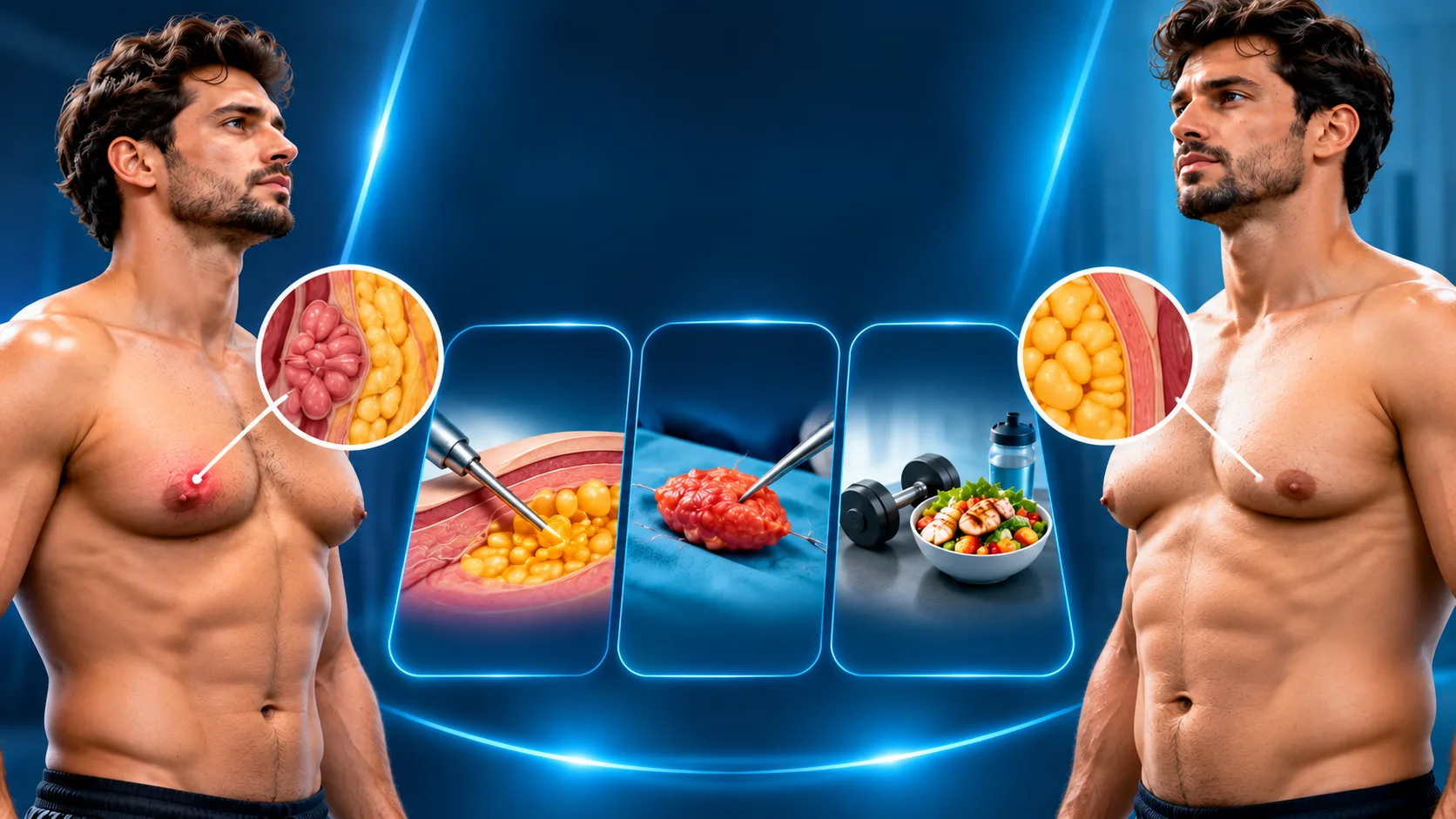
Gynecomastia vs Pseudogynecomastia Treatment: Liposuction, Gland Removal or Diet?
Gynecomastia is enlarged gland, pseudogynecomastia is excess fat. Learn how each is told apart, which treatments suit each, and what surgery in Istanbul costs.
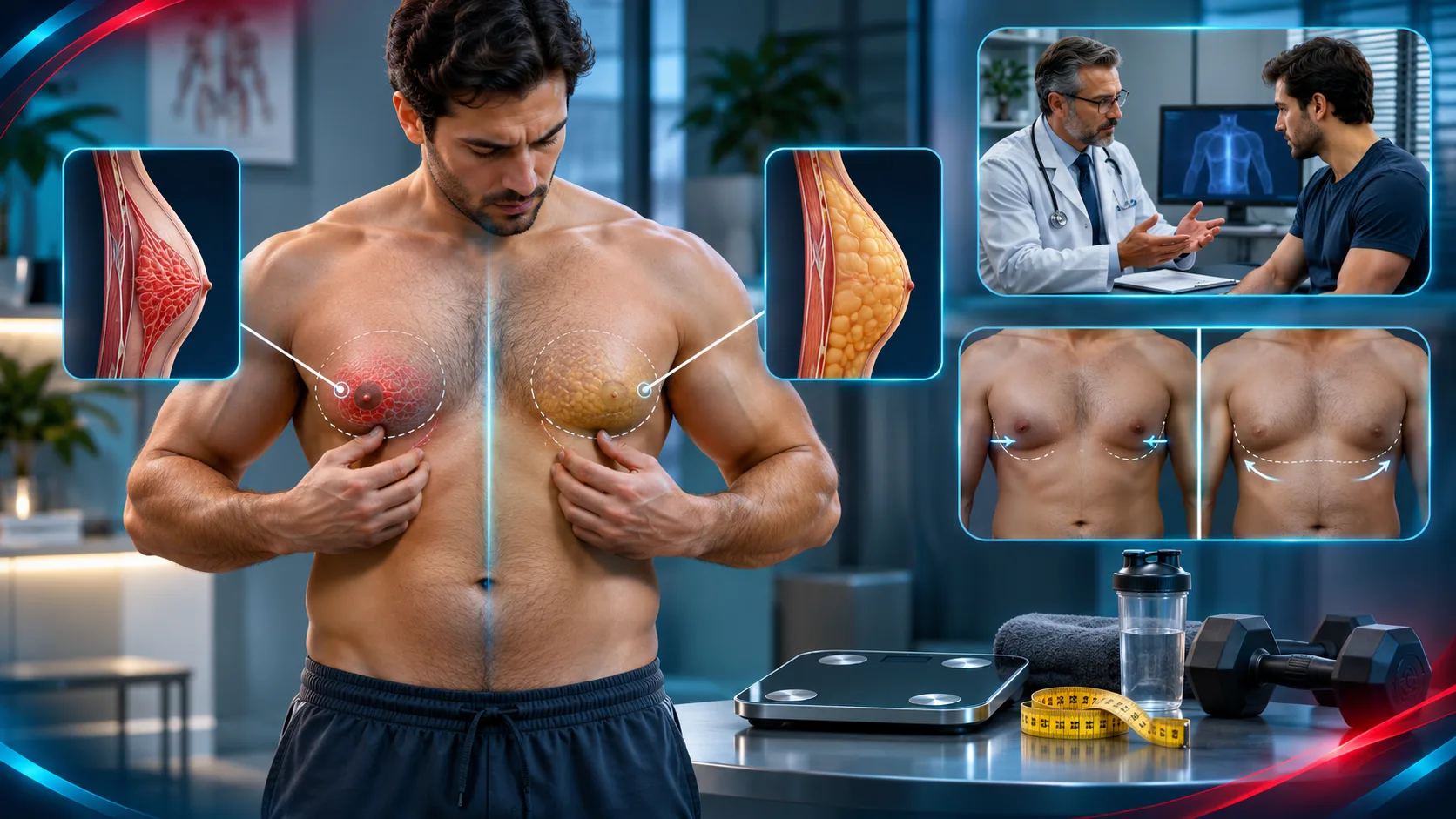
Gynecomastia vs Chest Fat: How to Tell the Difference (2027)
Gynecomastia vs chest fat comes down to one question: is there a firm disc of gland behind the nipple? This 2027 guide gives you a 5-step self-test, explains the causes of each, and shows which treatment actually works for gland, fat and mixed cases.