
Why Won't My Man Boobs Go Away? 7 Reasons You Can't Lose Man Breast Fat Even After Weight Loss
Stuck chest tissue after dieting? Discover seven common reasons weight loss may not shrink it, how to tell fat from gland, and when a doctor or surgeon should take a look.
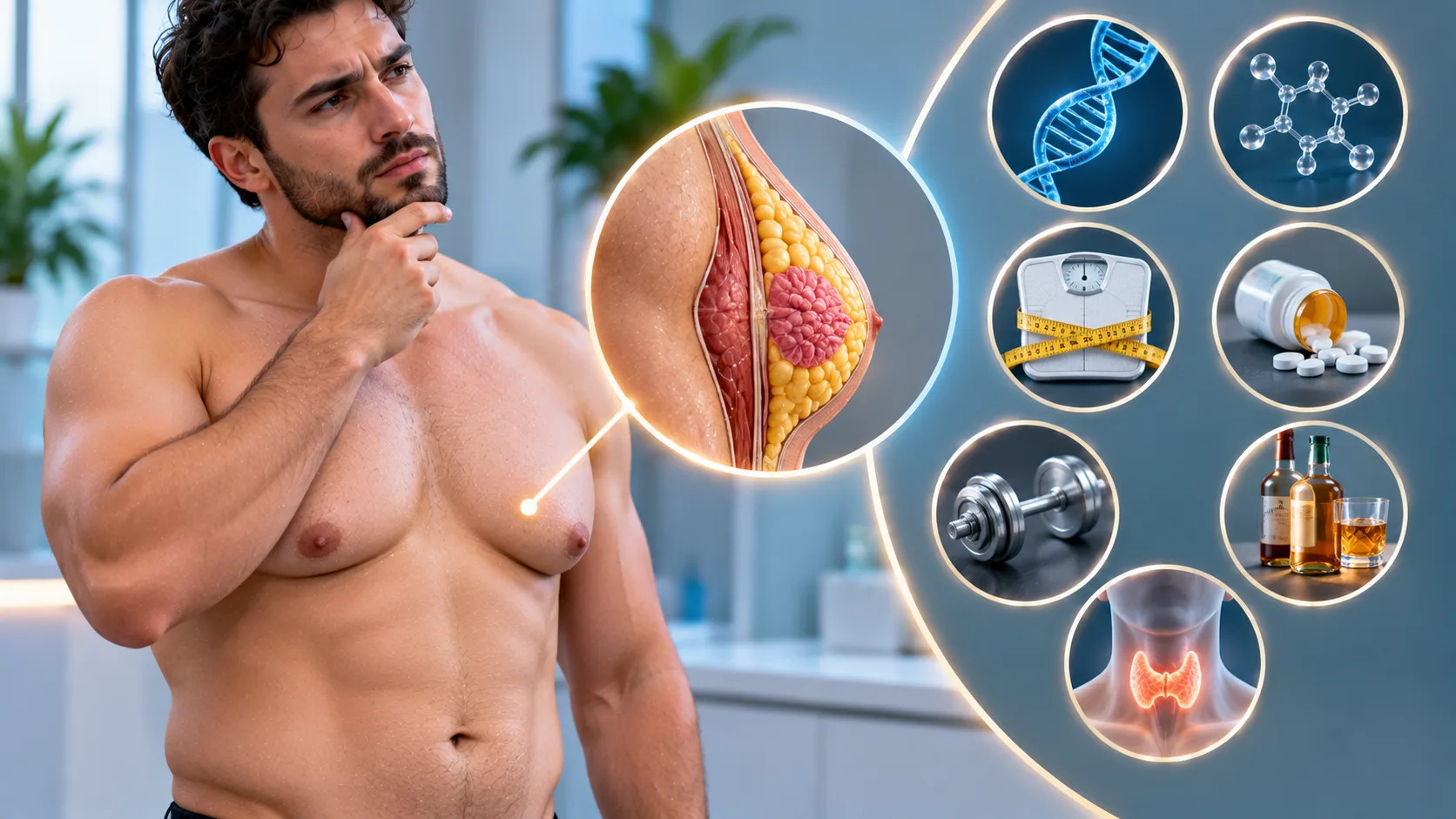
Your man boobs may not be going away because weight loss mainly removes fat, while the enlargement may be partly or entirely something else: glandular tissue, loose skin, or a change in hormone balance. That is why many men who have lost real weight still look the same across the chest. If you keep trying to lose man breast tissue and nothing changes, this guide explains the likely reasons, how to tell them apart, and what your options are.
For a clear overview of the two main types, start with our guide to gynecomastia vs pseudogynecomastia. This article then works through seven reasons, how to track real progress, what to ask a doctor, and what surgery can and cannot change.
Key takeaways
- Weight loss reduces fat well, but it does not remove glandular breast tissue or tighten skin that has stretched.
- Chest enlargement may be pseudogynecomastia (fat), true gynecomastia (gland), or a mix of both. Only a physical examination can tell them apart with confidence.
- Seven common reasons explain stubborn chest tissue, from where your body loses fat to medication, steroid use and medical conditions.
- Diet and training can help you lose man breast fat over several months. They cannot remove gland or excess skin.
- A hard lump, a growing lump on one side only, or nipple discharge needs a doctor's review, whatever your weight.
- If surgery is considered after a medical review, our all-inclusive packages in Istanbul start at $2,500 (flights excluded), and the right package depends on grade and procedure.
Why won't my man boobs go away even after losing weight?
Usually because the extra tissue is not only fat. Weight loss reduces fat, but it does not shrink glandular breast tissue, and it does not tighten skin that has stretched. Seven common reasons explain most stubborn cases, and two or more can overlap in the same man.
The table below summarizes the seven reasons, whether weight loss is likely to help, and who can confirm each one. Each reason has its own section later in this guide, so you can match the list to your own history rather than trying every fix at once.
| # | Likely reason | Does weight loss help? | Who can confirm it |
|---|---|---|---|
| 1 | Fat leaves the chest last | Yes, but slowly | Your own progress tracking, then a clinician |
| 2 | Glandular tissue (true gynecomastia) | Usually not | GP, specialist or surgeon |
| 3 | Loose skin left after weight loss | No; skin needs a different fix | Plastic surgeon |
| 4 | Shifted estrogen-to-testosterone balance | Sometimes, if weight-related | Doctor, often with blood tests |
| 5 | Side effect of a medication | Not on its own | Your prescriber |
| 6 | Anabolic steroids, prohormones or heavy drinking | Sometimes, after stopping | Doctor |
| 7 | An underlying medical condition | Depends on the cause | Doctor, promptly if warning signs appear |
It helps to think of your chest as a mixture of ingredients: fat, gland, skin and, in some men, a little muscle beneath. Weight loss only acts on the first ingredient. If the others make up most of the shape, the scale can fall a long way while the chest barely changes.
Picture a man whose body fat has come down across the abdomen and arms, but whose chest is mostly firm gland. His waistband is looser and his face looks leaner, yet the outline under his shirt is much the same. The scale and the mirror are telling two different stories, and that is usually a clue rather than a failure.
Can you lose man breast fat with diet alone, and is pseudogynecomastia reversible?
You can often reduce the fat part, but diet alone may not remove all of it, and it cannot remove glandular tissue. Pseudogynecomastia, the fat-only form, may shrink with sustained fat loss, while true gynecomastia usually stays. Whether this applies to you depends on what makes up your chest.
How fat-based change looks over time
Fat cells shrink when you lose weight, which is why many men notice a flatter chest after several months of steady change. The edges of the enlargement may become less defined, and the outline may look flatter from the side. Change is usually gradual, so photos taken in the same conditions each month are more useful than a daily look in the mirror.
Those fat cells can also refill if weight returns, so the result lasts only as long as the habits behind it. This is the basis of most pseudogynecomastia weight loss progress: the fat component responds to energy balance, and it responds best when the new weight is maintained rather than briefly reached.
Is pseudogynecomastia reversible?
For many men, the fat-based part is reversible in the practical sense that it can be reduced and kept reduced. It is not reversible in the sense of disappearing entirely in every case, because some men keep a small amount of fat over the chest even at a healthy weight.
Glandular tissue is different. It is made of breast ducts and supporting tissue, and reducing body fat does not remove it. Weight loss may still improve the softness and overall look of a mixed chest, which is why the honest answer for many men is that the change is only partly reversible.
Some causes can be addressed at the source. If a medicine is contributing, a prescriber may review it. If steroids or prohormones triggered the change, the tissue may not fully resolve after stopping, particularly if it has been present for some time. Hormone-related causes may improve once the underlying problem is treated under medical supervision.
What diet and training can realistically do
Sustainable habits do most of the work. A moderate calorie deficit that you can keep for months is more useful than a crash plan that is hard to maintain and often leads to regain. Adequate protein at each meal helps preserve muscle while fat is lost, and regular resistance training across the whole body supports a firmer shape once the weight has come down.
Sleep and stress also matter, because both affect appetite and hormone patterns. Reducing alcohol is one of the most direct changes many men can make, both for general health and because alcohol has been linked to chest enlargement in some men. A consistent routine is far more useful than short bursts of extreme effort.
Chest-specific exercises build the muscle beneath the fat, which can improve posture and the way the chest sits. They do not remove fat from that area. A realistic goal is to reduce the fat component, improve posture and muscle tone, and then assess what is left.
So, does pseudogynecomastia go away? Often it becomes smaller, but many men find it does not disappear completely through weight loss alone. Whether it is reversible for you depends on how much fat is present, how long your new weight stays stable, and whether something else is driving the change.
Pseudogynecomastia vs true gynecomastia weight loss: what changes and what stays
Weight loss is an effective tool for fat-based enlargement and a limited tool for glandular enlargement. The table compares how each type usually responds, so you can see which pattern is more likely to fit your chest. A clinician must confirm the pattern in person.
| Feature | Pseudogynecomastia (fat) | True gynecomastia (gland) |
|---|---|---|
| What makes up the enlargement | Fat only | Glandular tissue, sometimes with fat |
| Typical feel | Soft, doughy, moves with the chest | Firmer, rubbery, disc-like behind the nipple |
| Effect of weight loss | Can reduce size over months | Gland usually stays; surrounding fat may reduce |
| Role of diet and training | Can be significant | Can improve the overall look, not the gland |
| Often confirmed by | Clinical examination | Clinical examination; ultrasound may be used |
| Common surgical approach if it persists | VASER liposuction | Gland removal, often with liposuction |
Many men have a mix of both. A clinician can usually tell by examining your chest, and a surgeon will use that exam to decide whether liposuction alone is enough or whether gland removal is also needed. The mix matters because a plan built for pure fat will not remove a firm gland, and a plan built for gland may miss the fat around it.
Clinicians also grade gynecomastia by how much tissue and skin are involved. The Simon classification is one widely cited system. In broad terms, lower grades involve less tissue and little or no excess skin, while higher grades involve more tissue and more skin. Grade affects which treatment is appropriate, which is why the same complaint can lead to very different plans.
The useful question is therefore not whether your chest is fat or not, but what makes it up and how much of each part is there. Answering that properly is the purpose of the examination described later in this guide.
How long does it take to see results from losing weight on your chest?
Fat-based changes often take several months to show clearly, and the chest may be one of the slower areas to respond. Gland does not respond to weight loss in the same way, so a plateau on the chest after a stable period may be a sign to see a clinician rather than to push harder.
Many men who try to lose man breast fat expect faster results than their body can deliver. The table below describes general patterns. Individual timelines vary widely with starting weight, age, body composition, hormones and how consistently the new routine is kept, so treat these as orientation rather than promises.
| Period | What you may notice | What to do |
|---|---|---|
| Weeks 0–4 | Little visible change; the scale may move first | Set a baseline: photos, weight, chest measurement |
| Months 1–3 | Edges may soften; chest may look flatter from the side | Repeat photos in the same conditions each month |
| Months 3–6 | A clearer picture of what fat remains | Review progress with a clinician if little has changed |
| After 6 months at a stable weight | Remaining shape is easier to judge | Book a medical review if the chest is unchanged or worsening |
A common mistake is to measure progress by the scale alone. A man can lose several kilograms, feel much better, and still see only modest change in the chest if gland is involved. Another mistake is to change routines constantly, which makes it hard to know what is working. Keeping one consistent plan for a defined period gives a much clearer answer.
If the chest has not changed after a stable period, that does not mean you have failed. It means the next step should be a medical and physical assessment, rather than more of the same effort.
Reason 1: Fat leaves your body in an order you cannot choose
Your body decides where fat is lost first, and for many men the chest is one of the slower areas to change. This is a pattern rather than a rule, so some men see chest change early, while others see the face, arms and abdomen change long before the chest does.
Why the chest may be the last area to change
Fat distribution is influenced by genetics, age and hormones, which is why two men of the same weight can look very different. Fat in the chest can respond at a different pace from fat elsewhere, so it may take longer to shift. The exact order is not something you can override with willpower.
Spot reduction, the idea that training one area burns fat from that area, is not supported by the evidence. Chest exercises build the pectoral muscles underneath, which can help posture and shape, but they do not remove the fat on top. Sit-ups do not remove abdominal fat for the same reason.
This is why many men feel frustrated after months of push-ups and bench presses. Many men trying to lose man breast fat through training are surprised by this. The effort is useful for strength and posture, but it does not target the tissue that is causing the change in outline.
The scale can hide real progress
Body weight can stay steady while body fat falls and muscle replaces it. The scale may suggest nothing is happening when the chest is actually changing. This is especially common in the first months of a new training routine.
A tape measure can help. Measure around the chest at nipple level, at the same time of day and with the same tension each time, and record it alongside your waist. Photos every four weeks in the same light, posture and position give a clearer picture than comparing your reflection each morning.
Posture matters too. Rounded shoulders can make the chest look fuller than it is, while standing tall and relaxed can change the outline noticeably. When you compare photos, keep your posture consistent so that you are measuring change, not slumping.
Reason 2: The enlargement may be glandular, not fat
If the tissue directly behind the nipple feels firm and rubbery, the enlargement may be true gynecomastia. Glandular tissue does not shrink with calorie reduction the way fat does, so weight loss alone may leave the shape almost unchanged.
What glandular tissue can feel like
Glandular tissue often feels like a firm, disc-shaped area under the nipple and areola. It may feel tender, and it can differ in size from one side to the other. The edge of the disc may be easier to feel than the centre of it. Fat, by contrast, is usually soft and spreads out toward the armpit and the rest of the chest.
It can occur in men of normal weight, so a slim man with a firm area should still have it checked. Weight is not a reliable guide on its own, and many men with gland-based enlargement are surprised to learn that their body fat is not the main issue.
Why this changes your plan
If you have dieted for months and the firm area has not changed, that is not a personal failure. It suggests the problem may need a different approach, such as a medical review and, in some cases, surgery to remove the gland. Recognizing this early can save months of effort spent on the wrong strategy.
A clinician may use an ultrasound scan when the diagnosis is uncertain or when a lump is present. Ultrasound can help distinguish gland from fat and assess any lump, but it is one tool among several. The physical examination remains central.
Reason 3: Loose skin is left behind after weight loss
If you have lost a large amount of weight, the skin over your chest may not fully shrink back. Loose or hanging skin is a separate issue, and diet and exercise cannot fix it. This is one of the most common reasons men feel that their efforts have not worked.
Skin elasticity varies with age, genetics and how quickly the weight came off. When skin has stretched for a long time, it may stay loose even after the fat underneath has gone. Gradual weight loss gives the skin more time to adapt, but that is not guaranteed, and some men are left with excess skin even after careful, steady progress.
Liposuction removes fat but does not tighten skin in the same way, which is why some men still look baggy after months of effort to lose man breast fat. The skin may need a separate procedure. This is one reason surgeons assess skin quality as part of the consultation rather than treating the chest as a single uniform problem.
How skin excess affects treatment
Excess skin is part of severity grading. Cases with more skin excess are handled differently, with skin tightening and, where needed, nipple repositioning. The pricing section later in this guide describes the package designed for advanced skin excess, which includes one hospital night.
Loose skin is a reason to speak with a plastic surgeon, not necessarily a sign that your efforts have failed. A surgeon can judge whether the skin is likely to settle with time, whether it needs removal or tightening, and how the nipple position may be affected.
Reason 4: Your estrogen-to-testosterone balance may have shifted
Breast tissue responds to the balance between estrogen and testosterone. When estrogen is relatively high compared with testosterone, the chest may enlarge. Body fat itself can contribute to that shift, which is one reason excess weight is linked to chest enlargement in men.
Fat tissue contains an enzyme called aromatase, which can convert some male hormones (androgens) into estrogen. More body fat can mean more of this conversion, and this is one reason weight-related chest enlargement often improves, at least partly, with weight loss. A review in the New England Journal of Medicine describes obesity and hormone changes as recognized causes of gynecomastia.
The effect works as a loop. Extra fat raises estrogen relative to testosterone, and the chest responds. When fat is reduced, that driver weakens, although gland that has already formed may not reverse on its own.
Other hormone-related causes
Other causes include low testosterone, thyroid problems and changes that occur around puberty and in older age. Puberty is a common time for temporary breast enlargement in boys, and many cases settle without treatment. Older men may notice changes as hormone levels shift with age, and any new change in later life deserves a medical check.
A doctor may arrange blood tests for testosterone, estradiol, luteinizing hormone, prolactin and thyroid function, depending on your symptoms and history. These results are interpreted together, and the timing and meaning of each result need a clinician to explain. Please do not start, stop or change any hormone treatment on your own. Those decisions belong to a clinician who has examined you.
What to tell the doctor
Bring a clear account of when the chest change began, whether it is one-sided or on both sides, whether it is tender, and what has changed in your weight, training, alcohol use and medicines over the same period. This history often guides the investigation more than any single test does.
Reason 5: A medication may be contributing
Some medicines can cause breast enlargement as a side effect. If the change began after you started a new prescription, or after a dose or combination changed, it is worth raising with your prescriber. This is a common cause that is easy to overlook because the medicine was prescribed for something else.
Examples described in medical literature include certain heart and blood pressure medicines such as spironolactone, some stomach acid medicines such as cimetidine, some antipsychotic medicines, and treatments that block androgens, including some used in prostate cancer care. The list is not complete, and the risk varies between people. Some supplements and herbal products can also affect hormones, so list everything you take when you see a doctor.
How to raise it with your prescriber
Make a short list before the appointment: the name of each medicine, when you started it, whether anything changed recently, and any supplements or over-the-counter products. Note when you first noticed the chest change, relative to those dates. If you want to know about alternatives, ask directly.
Please do not stop, reduce or change a prescribed medicine on your own. Many of these medicines treat serious conditions, and abrupt changes can be unsafe. Your prescriber can weigh the benefit of the medicine against the side effect and decide whether a change is appropriate.
Reason 6: Anabolic steroids, prohormones and heavy drinking
Anabolic steroids and prohormones can disrupt the hormone balance that controls breast tissue, and heavy alcohol use has been linked to chest enlargement in some men. These are among the causes a clinician will ask about directly, because they affect both the tissue and the healing after any surgery.
Anabolic steroids and prohormones are often used to build muscle, and they can raise estrogen relative to testosterone. If gland has already formed, it may not fully go away after stopping, particularly if it has been present for months. Being honest about past use with your doctor helps them make a safer assessment, and it is not a judgment about your character.
Stopping these substances is a medical decision with safety implications, and it can be harder than it sounds. If you are struggling with use, speak with a doctor about support rather than trying to manage it alone or swapping one substance for another.
Heavy drinking and the liver
Heavy drinking can affect the liver, which helps process hormones, and it has been linked to gynecomastia in some men. Cutting back is a practical step that also supports general health. If you are trying to lose man breast fat and drinking is part of your routine, reducing alcohol is one of the simplest changes to make, although it will not remove gland on its own.
Our own requirement is at least 3 months off steroids and prohormones before surgery. We ask about past use openly so that the plan is built on accurate information, and we would rather know the full history at the start.
Reason 7: An underlying medical condition may be involved
Some medical conditions can cause chest enlargement, including liver disease, kidney disease, thyroid disorders and low testosterone. Rarely, problems with the testicles, pituitary or adrenal glands, or certain tumors can change hormone levels. Most chest enlargement in men is not caused by a serious disease, but a doctor should rule out the rare serious causes rather than assume.
Liver disease, kidney failure and thyroid disorders can all alter hormone levels or how the body processes them. A doctor will ask about your symptoms, medical history and medicines, and may arrange tests. This is the one reason in this list where a delay can matter, so do not let a diet plan replace a medical check.
When a chest change needs urgent review
Some changes should not wait for the next routine appointment. A hard or fixed lump, a lump on one side only that is growing, nipple discharge, skin changes, or new tenderness that is one-sided or getting worse all need prompt assessment, whatever your weight or history.
See a doctor promptly if you notice any of the following:
- A hard or fixed lump in the chest or armpit
- A lump on one side only that is growing
- Nipple discharge, including clear fluid or blood
- Skin dimpling, puckering, or changes to the nipple or skin
- Chest tenderness that is new, one-sided or getting worse
Call your local emergency number straight away if you have chest pain with breathlessness, sweating or fainting.
Common myths about how to lose your man breasts
Most myths about how to lose your man breasts are partly true, which is why they persist. Weight loss does help many men, and exercise is good for health. The problem arises when a general truth is applied to a specific chest without checking what is actually making up the enlargement. The table separates the common myths from what is more accurate.
| Myth | What is more accurate |
|---|---|
| Chest exercises will flatten man boobs | They build the muscle underneath. They do not remove the fat on top. |
| Cardio burns chest fat first | Fat loss is spread across the body in an order set by genetics and hormones. |
| Losing weight always removes the enlargement | Fat usually reduces; firm gland usually stays. |
| Only overweight men develop it | Men of normal weight can have gland-based enlargement. |
| Tight clothing or a binder will shrink it | Tight clothing does not remove tissue. It changes appearance and can irritate the skin. |
| A firm area is just fat | Firm tissue behind the nipple needs a clinical examination to be sure. |
| If it is painless, it is nothing to check | A painless change still deserves review if it is growing, one-sided or has other features. |
How to tell whether your chest is fat, gland or both
You can get a rough idea at home, but only an examination can confirm which type you have. Pinch the tissue beside the nipple, then the tissue directly beneath it. Fat usually feels soft and moves freely, while gland feels firmer and more rubbery and may sit in a defined disc.
Work through the check in this order. First, relax your arm and pinch the fatty tissue at the side of the chest, toward the armpit, to get a sense of what soft tissue feels like. Second, pinch the area directly beneath the nipple and areola and note whether there is a firm, disc-like edge. Third, compare both sides. Differences between left and right are common, but they deserve a proper check if they are new.
A home check has limits. Mixed cases are common, differences can be subtle, and self-checking is not a diagnosis. Your own judgment can also be affected by how you feel about your body, so a clinician's neutral examination is more reliable than your own reading.
The table shows the main ways clinicians assess the chest and what each method can and cannot tell you.
| Method | What it helps show | Limits |
|---|---|---|
| Home pinch test | A rough sense of firm versus soft tissue | Cannot reliably separate mixed cases |
| Clinical examination by a doctor or surgeon | Usually distinguishes fat from gland | Depends on the examiner and on how much fat covers the gland |
| Ultrasound | Shows gland versus fat and helps assess lumps | Used when a lump or doubt is present |
| Mammogram | Imaging used in some assessments | Not routine for every man |
| Blood tests | Hormone and organ function levels | Results need a clinician to interpret |
Clinicians may use the Simon classification to describe severity, as mentioned earlier. Grading helps guide the choice between liposuction, gland removal, skin work or a combination, and it gives a shared language for discussing your options.
Photos can help a surgeon form an early view, which is why our free assessment asks for front and side photos. Photos cannot replace an in-person examination, and they cannot confirm a medical diagnosis.
Pseudogynecomastia after weight loss: what to do before considering surgery
Before surgery is considered, most surgeons want to see stable weight, a medical check and a fair trial of lifestyle changes. This gives you the best chance of knowing what is left to treat. It also avoids planning around a target that is still moving, which can lead to disappointment or an unnecessary operation.
Pseudogynecomastia after weight loss is often best judged once the fat has settled. A few months of consistent habits gives a more reliable picture than a few weeks, and a clear medical history helps your surgeon decide whether the remaining tissue is fat, gland or skin.
Practical steps include:
- Keep a consistent routine for several months, and record your weight and chest photos at the same points each month.
- Get a medical check, especially if the enlargement is new, one-sided or painful.
- Review all medicines and supplements with your prescriber.
- Cut back on alcohol, and be open about any past steroid or prohormone use.
- Stop smoking, because smoking can affect healing. Our own rule is no smoking for 4 weeks before and after surgery.
Our candidate criteria ask for a stable weight for 6 months, because the chest is easier to assess once the fat has settled. Candidates are generally 18 or older.
If you are weighing up your options, our guide to gynecomastia vs pseudogynecomastia treatment compares liposuction, gland removal and diet-based approaches side by side.
Setting realistic goals for pseudogynecomastia weight loss
Realistic goals are specific and measurable. A goal such as reducing the chest outline and improving posture over six months is more useful than aiming to remove it completely. A measurable goal also makes it easier to decide when progress has stalled and a clinician should look at the chest again.
Be wary of anyone who promises a fixed outcome from diet or supplements. Results vary, and no weight-loss plan can reliably remove firm gland or excess skin.
How to track progress so you know whether the chest is changing
Track your chest using the same photos, measurements and conditions each month, so that you can see whether it is changing. Tracking is the best way to tell whether you are losing man breast fat or only losing weight. A simple, consistent record for three to six months will tell you more than months of unrecorded effort.
Use the same method each time. Take photos in the same room, with the same light, the same distance from the camera and the same relaxed posture. Measure your chest at the same height and time of day. Record your weight once a week rather than daily, because daily weight moves with water and food.
| What to record | How often | Why it matters |
|---|---|---|
| Front and side photos, same light and posture | Every 4 weeks | Shows change in outline that the scale misses |
| Chest measurement at nipple level | Every 4 weeks | Gives a number you can compare over time |
| Waist measurement | Every 4 weeks | Shows whether overall fat is falling |
| Body weight | Weekly average | Shows the overall trend |
| Medicines, supplements and alcohol | Ongoing notes | Helps your doctor link changes to causes |
| Training and sleep | Weekly notes | Helps explain plateaus |
Once you have three to six months of consistent records, review them. If the chest has softened and flattened, the fat component is likely responding. If it has not changed despite stable weight and steady habits, that is useful information for a clinician, and a reason to book a medical review.
Questions to ask your doctor about stubborn chest tissue
Ask your doctor whether the chest is mainly fat, gland, skin or a mix, and whether any medicine or hormone issue could be involved. Prepare a short list so that you leave with a clear answer about the cause and the next step. This matters most if you have already tried several approaches without success.
Useful questions include:
- Is my chest enlargement mainly fat, gland, skin, or a mix of these?
- Could any of my current medicines or supplements be contributing?
- Do my symptoms suggest a hormone-related cause, and do I need blood tests?
- Should I have my thyroid or liver checked?
- Should I have an ultrasound, and what would it show?
- What would you expect to change with time, and what would you expect to stay?
- If the chest does not change, what are my options from here?
- Is there anything in my history, such as past steroid use or alcohol, that you need to know?
Write down the answers, and ask for clarity if a term is unfamiliar.
When surgery is worth considering for stubborn chest tissue in Istanbul
Surgery may be worth considering if chest enlargement persists after a stable weight and a medical review, and it affects your comfort or confidence. The right procedure depends on whether the problem is fat, gland, skin or a combination, and a surgeon must confirm this in person. Surgery is not the first step to lose man breast tissue, and it should follow the review rather than replace it.
VASER liposuction uses ultrasound energy to break down fat before it is removed through small incisions. It is suited to fat-based enlargement, and it can reshape the contour of the chest. Gland removal takes out the glandular tissue, often through incisions around or near the areola. Where skin excess is present, skin work and nipple repositioning may be part of the plan.
The NHS lists male breast reduction among cosmetic procedures, describing it as surgery to remove excess breast tissue and/or fat. It is worth reading that description alongside a surgeon's assessment so that you understand what the operation can and cannot do.
We are based in Etiler, Istanbul, and perform surgery in JCI-accredited private hospitals in Istanbul and Ankara. For an overview of how our program works, see our page on gynecomastia surgery in Turkey. Candidates are generally 18 or older, have held a stable weight for 6 months, have been off steroids or prohormones for at least 3 months, and do not smoke for 4 weeks before and after surgery.
Who should wait before booking
Some men are not ready for surgery yet, and that is a sensible outcome rather than a rejection. You should probably wait if your weight is still changing, if you have used steroids or prohormones within the last 3 months, if you are smoking, or if a medical question remains unanswered. Anyone under 18 should speak with a doctor and a parent or guardian rather than consider treatment.
Waiting also gives time for a clear diagnosis. If a medical condition is found, treating it may change the picture, and surgery should be considered only after that is understood.
What surgery can and cannot change
Surgery can remove fat, remove gland, and address excess skin, depending on the procedure. It cannot guarantee a specific shape or perfect symmetry, and it does not remove the need for habits that keep the result stable. It is best understood as a precise tool for particular tissues, not as a complete replacement for good health.
Like any operation, it carries risks. These can include bleeding, infection, fluid collection under the skin, scarring, changes to nipple or skin sensation, asymmetry, irregularities in the contour, and the need for a further procedure. Anesthesia carries its own risks, which your anesthesiologist will explain. Your surgeon should discuss these in relation to your health, not as a generic list.
Results develop over time. Early swelling and bruising are expected and gradually settle, and the final shape can take several months to show. Judging the result too early is one of the most common sources of disappointment. Scar placement depends on the procedure, and your surgeon will explain where incisions will be and how they are likely to look.
Package prices and what is included
The right package depends on the grade and the procedure you need, not on guesswork. Our 2026 packages are all-inclusive, and flights are excluded. The table lists each package, who it suits and its price.
| Package (2026) | Best suited to | Price (all-inclusive) |
|---|---|---|
| VASER liposuction only | Grade I, pseudogynecomastia | $2,500 |
| VASER + gland excision | Grade I–II, our most popular option | $3,000 |
| Hi-Def VASER + excision | Those wanting more defined contouring | $3,500 |
| Grade III–IV with skin tightening and nipple repositioning | Advanced skin excess (1 hospital night) | $4,200 |
| Gynecomastia + full-torso VASER | Gland removal plus wider torso contouring | $5,500 |
The package you are quoted will depend on your assessment, not on the price list alone. A liposuction-only plan may suit a man whose chest is mostly fat, while a man with a firm gland and skin excess may need a more involved package. This is why a fixed quote follows a review of your photos and history.
For comparison, typical quoted prices for similar surgery at home, as listed on our site, are about $8,000 in the USA and £5,500–6,500 in the UK. Compare like with like, including travel, time off work and aftercare, rather than the headline figure alone.
Every package includes surgery, the anesthesiologist, hospital care, 3–5 nights in a 5-star hotel, VIP transfers, a translator, a compression vest, medications, pre-operative tests, histology (laboratory examination of the removed tissue), nurse visits on days 2–3, video follow-ups at weeks 1, 2, 4 and 8, and lifetime WhatsApp aftercare. Flights are the main cost that is not included.
Trip length and recovery timeline
A typical trip is 4–6 days. Surgery takes 1–2 hours under general anesthesia. Most patients fly home on day 3 or 4, or day 5 or 6 for grade III–IV cases. Recovery follows a predictable pattern, though everyone heals at a slightly different pace.
| Stage | Typical timing |
|---|---|
| Trip length | 4–6 days |
| Surgery | 1–2 hours under general anesthesia |
| Flying home | Day 3–4 (grade III–IV: day 5–6) |
| Desk work | 5–7 days |
| Lower-body gym | About 2 weeks |
| Chest training | 4–6 weeks |
| Compression vest | 4–6 weeks |
| Final result | 3–6 months |
Plan the trip carefully. Bring loose, comfortable clothing that is easy to put on over a compression vest, and think about how you will manage the first days at home. Desk work is generally possible after 5–7 days, but physically demanding work takes longer, and your surgeon will confirm the right timing for you.
Follow-up is built into the program, with nurse visits on days 2–3 and video follow-ups at weeks 1, 2, 4 and 8. Lifetime WhatsApp aftercare means you can ask questions after the trip, although urgent symptoms should always be assessed in person by a local doctor.
Clinic figures and what they mean
Our clinic's own internal audit, which has not been peer reviewed, reports more than 5,000 procedures, a revision rate under 1%, 98% patient satisfaction, a 4.9/5 average rating and patients from more than 50 countries. Please treat these as our own internal figures rather than independent research.
You can review gynecomastia before and after photos to see the range of results across different grades. Results vary between patients, so photos show possibilities rather than promises.
How to get a free photo assessment that shows what is left to treat
If you have already tried diet, training and time, the most useful next step is a clear answer about which type of enlargement you have. Our free assessment is designed for exactly that situation. Send two photos, one from the front and one from the side, taken in normal lighting while you are relaxed.
A surgeon reviews your photos and sends a fixed quote within 24 hours. There is no charge and no obligation to book. The assessment is based on photos, so final suitability is confirmed at a consultation, and the quote does not replace a medical diagnosis.
How to take the photos
Use natural daylight or a bright, even room light, and avoid strong shadows across the chest. Stand relaxed with your arms by your sides and your shoulders natural rather than pulled back. Frame the photos so that the chest, shoulders and waist are visible, and take the front and side photos at the same distance. Avoid tight or loose clothing that changes the outline of the chest.
If you have photos from your tracking, send the most recent set. Consistency matters more than perfection, so a clear, honest photo is more useful than an edited one.
What the assessment can and cannot tell you
The assessment can help a surgeon form an early view of whether the chest looks mainly fat-based, gland-based or mixed, and whether it may need skin work. It can also indicate whether an in-person consultation is the sensible next step. It cannot confirm a diagnosis, rule out a medical condition or guarantee a result.
If you have a lump, nipple discharge, a one-sided change or any other concerning symptom, see a doctor promptly rather than waiting for an assessment.
You can reach us on WhatsApp at +90 505 026 5581 or by email at info@gynecomastiasurgeryturkey.com.
If the answer is that fat alone is the problem, a liposuction-only plan may be enough. If gland or skin is involved, you will know exactly what the next step is, and you will be able to make that decision with a clear picture of your options.
Frequently asked questions
Straight answers from our surgical team.
Does pseudogynecomastia go away on its own?
Is pseudogynecomastia reversible?
How can I tell if I have pseudogynecomastia or true gynecomastia?
Why do my man boobs still look big after losing a lot of weight?
How long should I wait after weight loss before considering surgery?
How much does gynecomastia surgery in Turkey cost?
Is the photo assessment really free and without obligation?
Get your free surgical assessment
Send two chest photos (front and side). A board-certified surgeon reviews them and you receive a personal plan and an exact all-inclusive price within 24 hours.
No obligation. Your photos are deleted on request. or call +90 505 026 5581
- 1.Send photos
- 2.Surgeon review
- 3.Fixed quote in 24h
This guide is for educational purposes and does not replace a consultation with a qualified surgeon.
Related guides
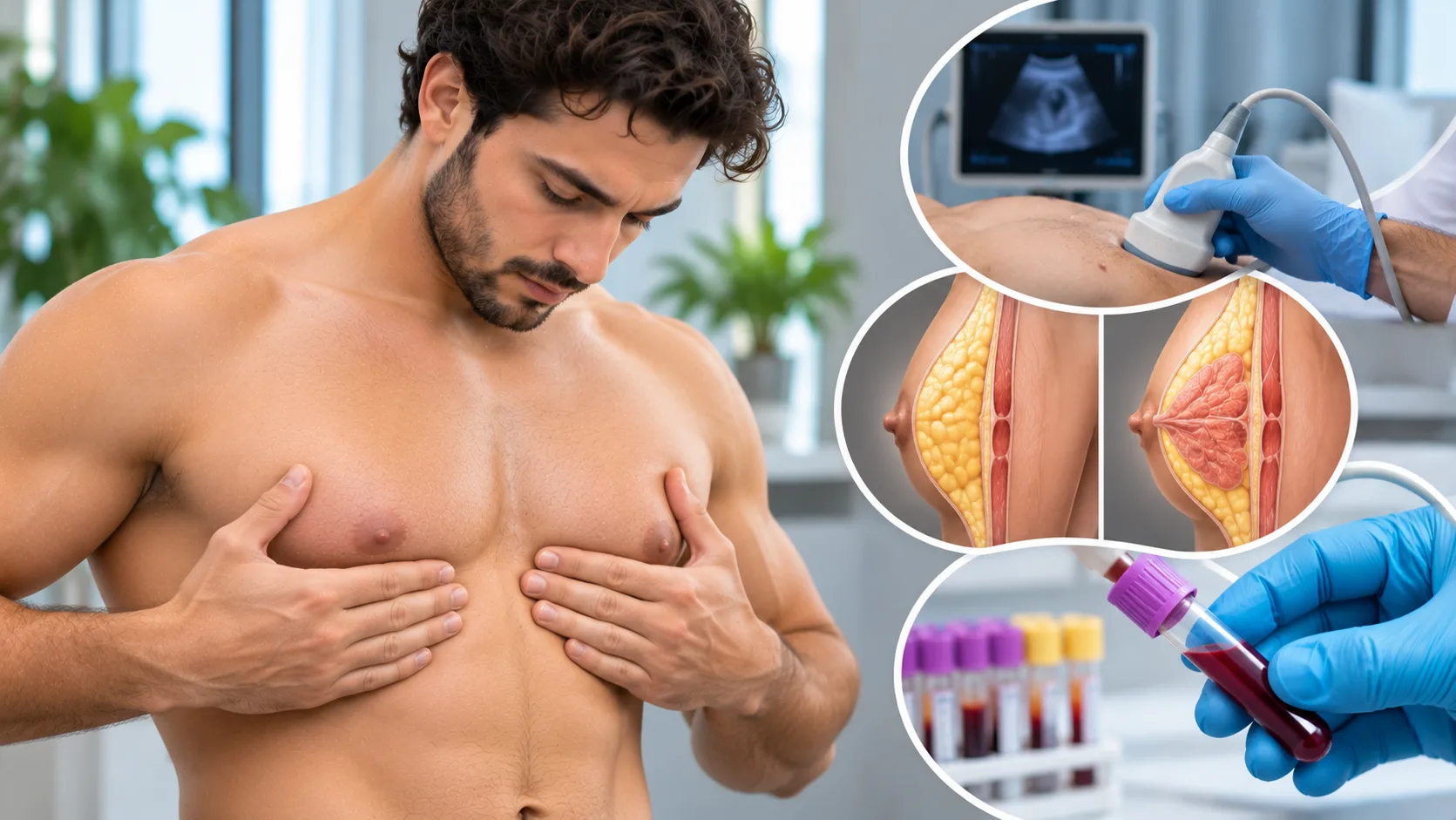
Gynecomastia Test: Self-Check, Ultrasound & Blood Tests Explained
There is no single gynecomastia test. Learn the self-check, blood tests and ultrasound doctors use, how to tell fat from glandular tissue, and when to see a doctor.
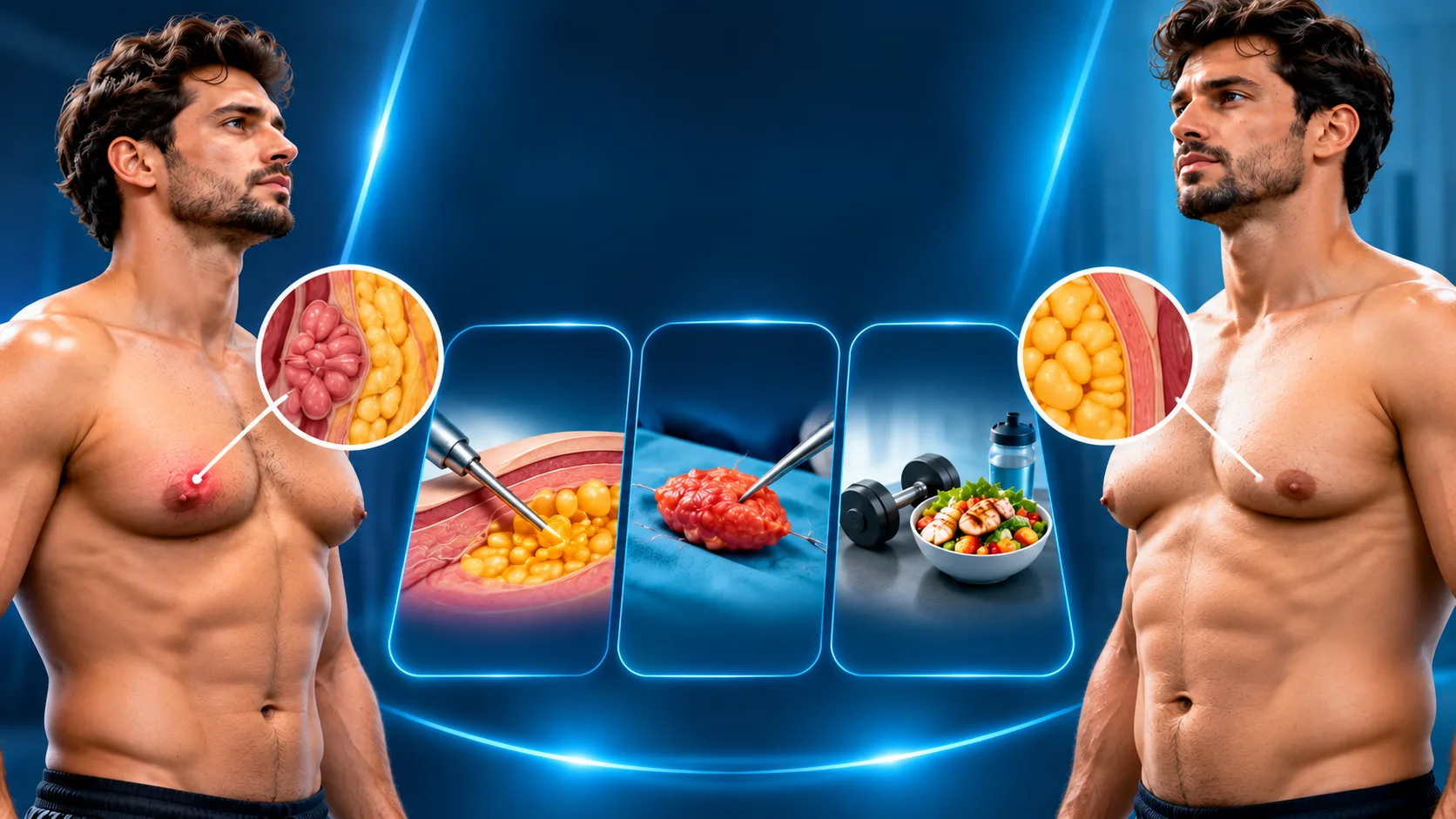
Gynecomastia vs Pseudogynecomastia Treatment: Liposuction, Gland Removal or Diet?
Gynecomastia is enlarged gland, pseudogynecomastia is excess fat. Learn how each is told apart, which treatments suit each, and what surgery in Istanbul costs.
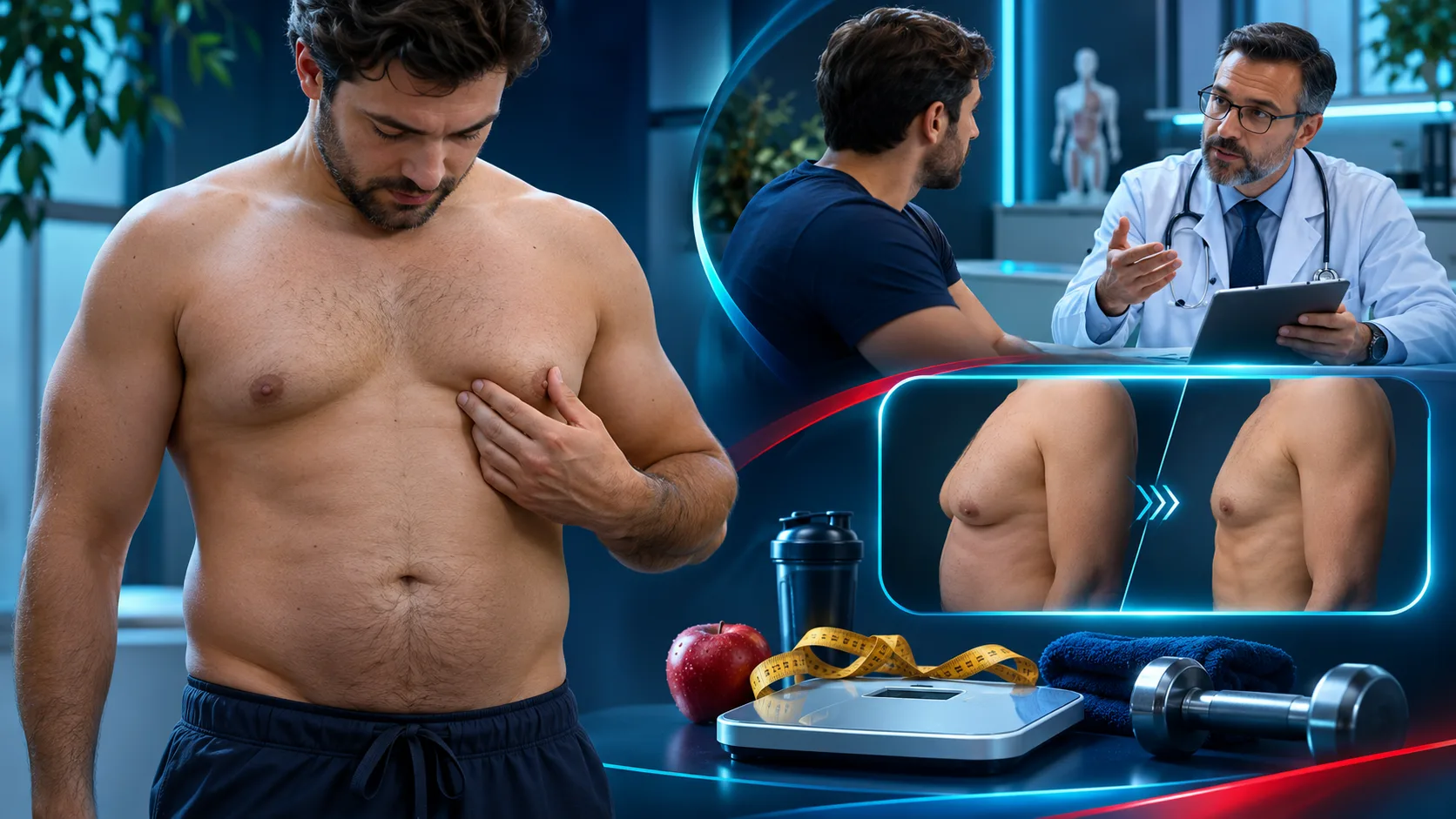
What Is Pseudogynecomastia? Causes, Symptoms & Pictures
Pseudogynecomastia means a chest that looks enlarged because of fat, not breast gland. Learn the causes, symptoms, examples, how it is diagnosed and treated, and how to get a free photo review.